Pages

Showing posts with label ume (Japanese apricot). Show all posts

Monday, March 2, 2026

Ume blossoms and light-up in the Toji Temple Garden


梅一輪 一輪ほどの 暖かさ
Ume ichirin, ichirin hodono, atatakasa

One Ume blossom
One blossom's
Worth of warmth

- 服部嵐雪 Hattori Ransetsu (1654-1707)  -

This haiku-poem has a preface that refers to the Ume blossom as a 寒梅 "winter Ume." 
寒梅 winter ume tree that blossoms in cold winter is a seasonal word for late winter, while 梅 Ume is for spring.
Ume, Japanese apricot, is the harbinger of spring in Japan.


When I was in the Toji Temple Garden with Ume trees in full bloom in the late February, 
it felt like that the weather was becoming warmer with each new bloom of 梅 Ume tree.
It was so warm that I could describe "full bloom worth of warmth" rather than
 "one blossom's worth of warmth".


河津桜 Kawazu-zakura, an early-flowering variety of cherry tree, were also almost in full bloom.


Numerous bamboo lanterns and bamboo balls are displayed for the light-up 東寺月回廊 To-ji Moon Corridor.

Multiple bamboo balls are suspended over Hyotan pond ....


.... and are hanging along the Moon Corridor.


When all the bamboo balls and lanterns are lit up, you're transformed into the ethereal world,
which is completely different from the daytime.


Despite the warmth of the daytime, the night was so chilly.
As usual, temporary warm spells will be interrupted by lingering, volatile winter conditions 
before the real spring is here.

- A little about Toji Temple -
Toji Temple (World Heritage) was built in 796 shortly after the capital was moved to Heian-kyo (Kyoto).
In 823, Kobo Daishi (Kukai) was entrusted by the reigning emperor, making it a key center for Shingon Buddhism.
The Five Storied Pagoda (National Treasure, reconstruction in 1644) is the tallest in Japan.


Linked to Mosaic Monday

Sunday, March 16, 2025

At the pond surrounded by Ume Blossoms


A pond surrounded by 梅 Ume trees in the garden of Iraka is one of my favorite places 
at this time of year.

Shooting into the sun is good for a monochrome photo.


The pond is a flowered mirror in the sunlight.


In the breeze, reflected blossoms shift and change patterns like an ever-moving Kaleidoscope.


梅 Ume, or Japanese Apricot, is harbinger of spring in Japan,
a symbol of hope and renewal.
They are also associated with resilience and perseverance as they keep blooming
through the cold of winter to brighten up the wintry landscape little by little.


Winter Camellias are shining on the water surface with the sparkling light.


There is a sense of tranquility emanating from the place.


Linked to Mosaic Monday

Saturday, March 2, 2024

梅 Ume blossoms - Perseverance and Hope

The blossoms of 梅 Ume, Prunus mume, are the faint-fragrant harbinger of spring in Japan.
They typically bloom one after another between late January and early March
persevering the frigid cold of winter.
At this time of year, it feels like that weather gets warmer with each new bloom.
In various different places, the first bloom of Ume was the earliest in record this year.

Ume in my garden

I went to 城南宮 Jonan-gu, which was built to protect the south of Kyoto from evil spirit
 when the capital was transferred to Kyoto in 794.
On entering one of its gardens called "春の山 Spring Mountain", 
I felt like that white and pink snowflakes were drifting all around.


Almost all the Ume trees that cover all over the Spring Mountain are weeping type.
The cascading branches with blossoms as far as you can see are mesmerizing.
Under them, a pink carpet of petals spreads on the green moss.


Admired and photographed by so many visitors, the blossoms look in the pink.


The green moss is dotted with the fallen red Camellias around the edges of the Spring Mountain.


Ume blossom is the symbol of Perseverance and Hope.

Peace for Illia 
for all the suffering people from wars
 Illia Bondarenko & Ryuichi Sakamoto

Camellias are another highlight of the shrine at this time of year.


Linked to Mosaic Monday

Monday, March 21, 2022

Yugayama-enchi Garden

In one corner of Takabatake-cho, the old, nice and quiet residential area in Nara Park,
there used to be Nanto villa of Kichirobe Yamaguchi, successive presidents of 
Yamaguchi financial group of Osaka, from Meiji to Taisho periods (1868-1926).
It had long been abandoned until Nara Prefecture decided to utilize the historical,
 cultural asset to promote tourism.  
After the restoration work, it was open to the public in 2020 as Yugayama garden. 
It is located right across from the south side of Sagiike Pond.  
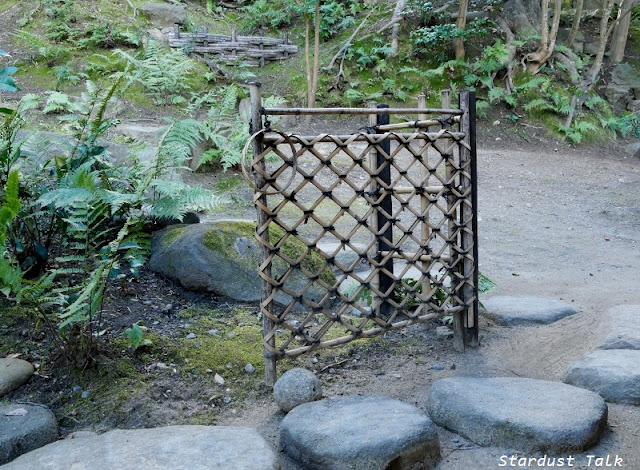
 Any tourists can enter the garden free of charge from the gate with deer-proof door. 
I was in the garden about a month ago before walking along the Sagi-ike Pond.
The pond is shown in the mid-February post, Wading birds and deer at Sagi-ike Pond.


There are a teahouse with an authentic ceremonial tearoom, a luxurious resort hotel
  Fufu Nara and its restaurant Tekisui in the 1.3-hectare strolling-style garden with a bamboo grove.
The first architecture you see after entering is a sukiya-style teahouse.


The next image is the west side of a restaurant "Tekisui".
The architectures are made with Nara’s historical "yamatobari" (overlapping wood panels) 
using Yoshino cedars from Yoshino forestry, a strong timber with closely packed rings.
Dark brown timbers and green lawn would be contrasting each other beautifully in other seasons.


This is a view opposite from the restaurant.  
Shall we go up the steps?


Ascending under the bamboo foliage, you see the hotel behind the bamboo grove.
The bamboo trees are like natural blinds for the privacy of the hotel customers
from the eyes of garden visitors strolling around freely.


Looking down, the restaurant is seen through the bamboo trees.


There is a path along the hedge made of bamboo which divides the upper and lower grounds.


This is thought to be from the Kamakura period (1192-1333).


This path leads to a tea-ceremony room at the backside of the teahouse 
which you saw on entering.


A lovely little gate to a small tea-ceremony room.
Though it was open, the tea-ceremony room was closed unfortunately.


In the late afternoon light of winter, I enjoyed my solitary walk
 monopolizing the garden almost all to myself.


Some meters eastward along the wall, there is an entrance to hotel and restaurant.
I look forward to having lunch or tea someday soon.


While the landscape has been brightening up from pale wintry colors,
 Ume (Prunus mume) blossoms were going to be over last week.

Ume blossoms

The first bloom of Sakura blossoms was officially announced yesterday in Tokyo.
It will be in a week or so here in Nara.

Linked to Mosaic Monday

Monday, March 1, 2021

Somewhere between winter and spring

It's March!
Ume blossoms, the floral harbinger of spring of Japan, have brightened up 
the pale wintry landscape.


March is the month when changes happen dramatically repeating cold and warm spells
as is Japanese saying 三寒四温 meaning "three cold days, four warm days."
This year, however, the changes have been occurring record early since the first snowfall in January.
Temperature topped 24C on February22.

Winter and spring have alternated.

Medical care workers are taking the first jab of vaccine against COVID-19
but the vaccination project is largely delayed.
Plans for spring is up in the air in spite of an air of expectation.
But spring will come for sure.


March 3 is time-honored Doll's Festival dedicated to girls.
One day in mid-February, I rolled up my sleeves and got busy to display 
a set of hina dolls on the seven-tired stand.
The time-consuming, tough work was paid off by the joyful reaction of 
three-year-old M living nearby.


Empress Doll and the view from the top

Dolls' Festival is a celebration for healthy growth and wellbeing of girls.
 Dolls are believed to protect people from diseases and misfortunes.
I'm thankful to be able  to watch over how my grandchildren (not only girls)
 growing individually through their various different challenges - ballet, 
swimming, abacus, music, shogi, flower arrangement, soccer, academic skills, etc.

Rolled sushi, gyoza, hamburger steak, bento for picnic, strawberry cake - all of my Grands like cooking.
F and Y finished the primary course of "Ikebana", the art of traditional flower arrangement.

Dolls' Festival is a tasteful celebration, too.
"Chirashi zushi/sushi" (bottom in the mosaic) is made with lotus roots, 
boiled shrimps, thinly shredded eggs, salmon roes or smoked salmons, etc., as you like, 
on the vinegared rice.
As to other delicacies, look at this past post Cheers to Hina dolls and Womanhood!


Last week, two of my friends and I got together, not virtual but in person at my home.
Air was chilly but the sun was quite kind while we were outside.
We had tasteful conversation wearing one or two masks...., 
wishing of the talk over lunch or refreshment someday as we used to do.


Linked to Mosaic Monday