Pages

Showing posts with label shrines. Show all posts

Saturday, March 2, 2024

梅 Ume blossoms - Perseverance and Hope

The blossoms of 梅 Ume, Prunus mume, are the faint-fragrant harbinger of spring in Japan.
They typically bloom one after another between late January and early March
persevering the frigid cold of winter.
At this time of year, it feels like that weather gets warmer with each new bloom.
In various different places, the first bloom of Ume was the earliest in record this year.

Ume in my garden

I went to 城南宮 Jonan-gu, which was built to protect the south of Kyoto from evil spirit
 when the capital was transferred to Kyoto in 794.
On entering one of its gardens called "春の山 Spring Mountain", 
I felt like that white and pink snowflakes were drifting all around.


Almost all the Ume trees that cover all over the Spring Mountain are weeping type.
The cascading branches with blossoms as far as you can see are mesmerizing.
Under them, a pink carpet of petals spreads on the green moss.


Admired and photographed by so many visitors, the blossoms look in the pink.


The green moss is dotted with the fallen red Camellias around the edges of the Spring Mountain.


Ume blossom is the symbol of Perseverance and Hope.

Peace for Illia 
for all the suffering people from wars
 Illia Bondarenko & Ryuichi Sakamoto

Camellias are another highlight of the shrine at this time of year.


Linked to Mosaic Monday

Monday, November 23, 2020

A morning walk in autumnal Nara Park

As my old blog friends might know already, there is no place named Nara Park on map in Nara City. It is the spacious area with fields, hills, woods and forest, mountains, brooks, temples and shrines including World Heritage sites, museums, residential area, and so on. Wild but friendly deer welcome visitors.

I strolled around some parts of Nara Park starting from Tobihino Hill last week.  Tobihino/飛火野 literally means “飛fly 火fire 野field.”  It is said that signal fires were launched there to inform people in the palace site of something in emergency in ancient times.

At the north edge of Tobihino, I came across a photo session conducted by a group of students.  I was part of it with some of other tourists before I knew it.


Then I walked into the woods of Kasuga Shrine founded in 8th century.  Shrine is for Shintoism, native religion of Japan. There's no founder, no doctrine, no script but simple nature worship or awe of nature for both beneficial and un-controllable power.  

 The woods are dark green with massive evergreens. 


Wisteria grow too wild without human maintenance.
The tangled twining vines have made gigantic sculptures or jungle gyms.


I named the sculptures below, clockwise from top-left;
"Vine garland", "Green man (right) and reptile (left)", "Knot", and "Dancing couple".


Coming out of the woods, I was at the path leading to the Kasuga Grand Shrine, which consists of the main shrine and many other small shrines. About 2000 moss-covered stone lanterns line the approach to the sanctuary. The oldest dates back to the Muromachi period (1336-1568).

Mini shrine and  stone lanterns

Leaving the shrine approach, I walked north to the Yoshiki River. The river is noted for Japanese Maple. The final blaze of the leaves felt coming soon.


Not only tinted leaves but also reflection is always intriguing.


And, barks as well.

Tree Lichens

One side of the river is Kasugano Park.


The buck above was not buried half in the ground but was rested in front of a  tree beyond a tiny hill.

A drifting leaf in the Kagami-ike Pond

Ukigumo Park, the other side of the river, was ablaze with Chinese Tallow leaves.  How mesmerizing!


My youngest grandchild M had a Shichi-Go-San (7-5-3) rite at Kasuga Grand Shrine. She’s going to be 3 next month. To finish it quick, M wore dress. She’ll have her commemorative photos taken at a photo studio in March, dressed in kimono with a lovely hairdo. She looks forward to becoming like a princess of Japanese period drama.  

One day at Mt. Wakakusa, collected leaves, and Shichi-Go-San

Today is Labor Thanksgiving Day, which stems from the ancient Shinto harvest festival since the start of rice cultivation. I can't thank enough for all the workers supporting our daily life, now especially health care workers.  This is really tough time for anyone in any situation. Probably old common sense (mask, sanitation of hands, gurgling), and social distancing and attitude to cooperate at the time of emergency as well, would be the best survival tools to go through this pandemic. Remember “mask” is the safest and the most affordable substitute for vaccine.


Linked to Mosaic Monday


Monday, February 24, 2020

Ume blossoms at the Kitano Tennmangu


東風吹かば
にほひをこせよ
梅の花
主なしととて
春な忘れそ

When the east wind blows
spread your scent
you plum blossoms!
Even though you lose your master
don't be oblivious to spring

This is a poem composed by Sugawara no Michizane (845-903),
a gentle scholar and politician, on leaving his home in Kyoto.
Due to the crime fabricated by his political enemy,
he was demoted from his aristocratic rank to a minor official
at the remote Dazaifu and died in exile.


Michizane's innocene was proved after his death.
Kitano Tenmangu Shrine was built in honor of Michizane
as well as for the peace of nation.

"After Michizane's death, plague and drought spread and sons of Emperor Daigo died in succession. The Imperial Palace's Great Audience Hall was struck repeatedly by lightning, and the city experienced weeks of rainstorms and floods. Attributing this to the angry spirit of the exiled Sugawara, the imperial court built a Shinto shrine called Kitano Tenman-gu in Kyoto, and dedicated it to him. They posthumously restored his title and office, and struck from the record any mention of his exile. Even this was not enough, and 70 year later Sugawara was deified as Tenjin-sama, or kami (god) of scholarship. Today many Shinto shrines in Japan are dedicated to him." (Excerpt from here)


"Kitano Tenmangu Shrine is the very first shrine in Japanese history
where an actual person was enshrined as a diety."
Many students visit the shrine wishing their success in entrance examination
as well as their improvement of academic abilities.


The very warm weather let the ume bloom two weeks earlier
 than the last year at the Kitano Tenmangu.
The blossoms must be wafting fragrance in the bracing air and the warm sunlight now.
These photos were taken in the beginning of March last year.
Recently I'v refrained from using public transportation when possible
or outing to the crowded places.


The Ume Garden was supposed to be lit up in the evening.
As a reflection freak, my eyes were glued to the reflections on the surface of candle containers.


At the kindergarten of boy Y, academic year-end performance was held 
prior to the graduation ceremony one month away.
The event features the violin performance by the eldest class members.
Almost all the members have learned playing the violin from scratch since April.
I simply wonder and respect how teachers taught violin to five/six-year-olds.
Children's version of The Grateful Crane, Japanese folktale
Twinkle, Twinkle, Little Star, and others

Linked to Mosaic Monday

Saturday, February 15, 2014

Silver white wonderland on Valentine's weekend


Hello, dear Friends!  Now that it turned mid-February, are you fed up with snow?  I guess perhaps so, but please bare it with me for a while because snow days in Nara is rare and special as I’ve written many times.


snow on ice at Obuchi-ike Pond
We had the second snowfall from 13th evening to 14th late night in Nara City. The snow was not ephemeral like the first time (Silver white landscape melted into rain) but long-lasting and in tremendous amount. Heavy snow warning was issued for the first time in 24 years. Schools and main highways were closed, trains delayed or suspended, traffic jammed terribly, and people injured on the icy road. You know how unprepared we are to the heavy snow.


I walked along my favorite walking course around the Obuchi-ike Pond, 
armed with water-proof coat and snow boots.
An exclusive residential area surrounds the pond.


Shohaku Art Museum stands in the estate of the late honorary president of  Kintetsu Railway Co.


the pond in autumn
There is Obuchi Bridge almost at the south end of the pond.


When you cross Obuchi Bridge, the scenery changes into rustic feel with traditional Japanese houses, woods, and fields.


In fifteen minutes' walk to the south-east of the pond, there is 御嶽山大和本宮 Ontake-san-Yamato-Hongu.  It is a Shinto shrine dedicated to Mt. Ontake.  It is noted for glorious cherry blossoms in spring but snow flowers on the branches are as good as or even better (if only you can brave the cold) than spring blossoms.


There was no one but me in the precinct. The only sound I heard was my breath as I trod on the snow and falling snow on my umbrella. The stones carved with the donaters' names looked standing into eternity.


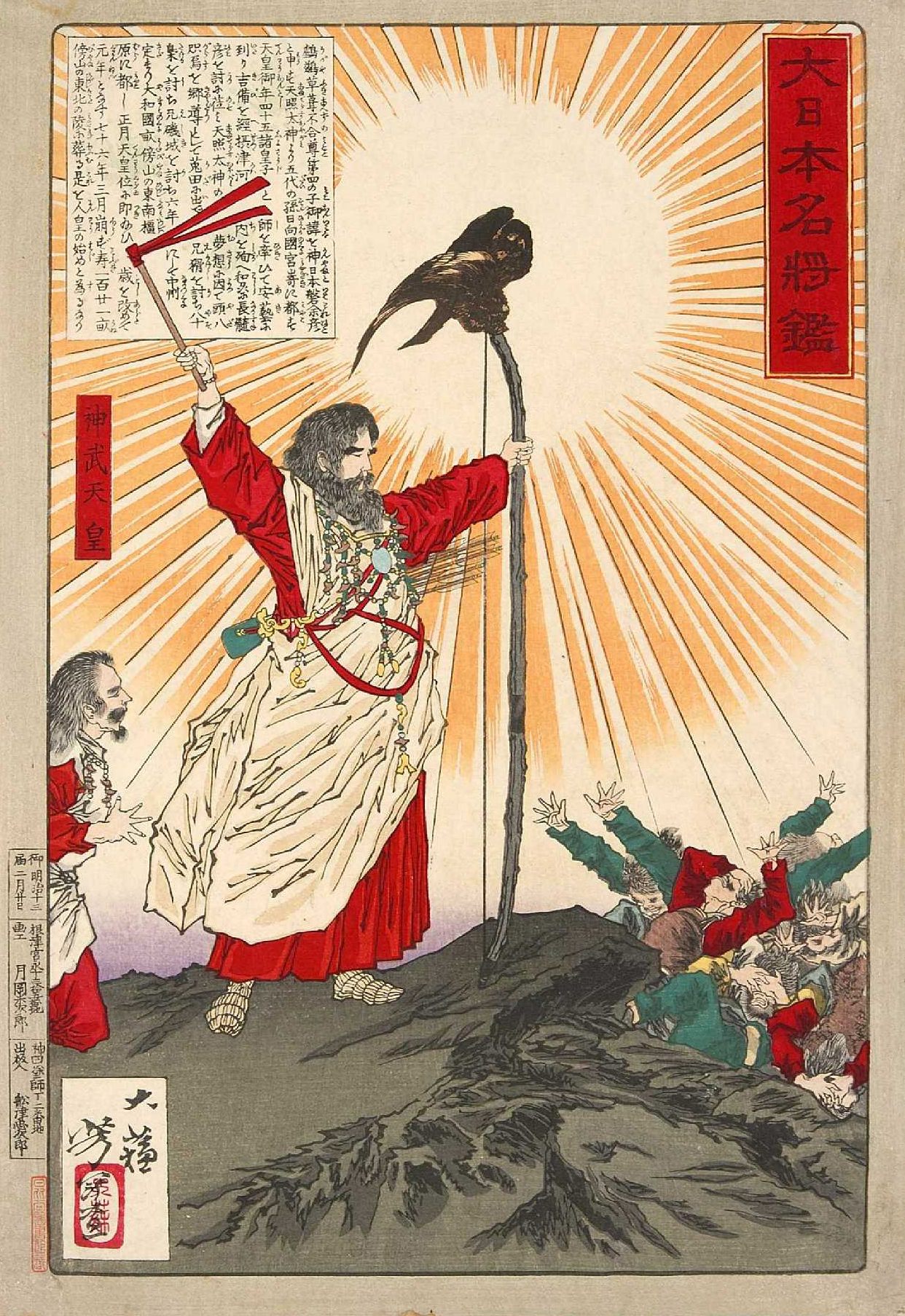
I sensed someone approaching, but there was no one.  Looking up, I saw a soaring warrior. I learned at home that he was Emperor Jimmu, the first emperor, with his emblematic long bow and an accompanying wild bird.  His reign was legendary 660 BC to 585 BC.


image via wikipedia


I was so absorbed in the serenity that I didn't realize I was wet and chilled to the bone until I came to myself after a while. I hurried back to home to warm myself and dry my camera, crossing that bridge again......


..... and walking along the pond back to the nearest bus stop.


Back home, I had a coffee break with some Valentine's Day chocolates with my husband.
Take care and stay warm!


February 18th

I’m having a break from blogging for a while.
To those who kindly left a comment after this notice, I’ll catch up on my returning.

Thank you, and see you!

Yoko