Pages

Showing posts with label rainy season. Show all posts

Wednesday, July 1, 2026

Under the leaden skies

We are currently in the middle of the rainy season, Tsuyu, or Apricot Rains.
I visited some places in Kyoto on a cloudy break in the season.

The Old Mitsui Family Shimogamo Villa was originally built in 1880, then relocated and
 extended in the south of Shimogamo Shrine in 1925.
 It served as a shared villa for the Mitsui family, one of the most prominent and influential
 merchant conglomerates in Japanese history.
 

You can sit on the traditional tatami mats and watch the garden covered with moss
and dotted with baloon flowers, which is one of the seasonal blooms.


The residence features a moss garden with a gourd-shaped pond that mirrors 
the deep green hues.


There is a winding stroll path along the waters edge.
You can look at the historic three-story Taisho-era residence.


The third-floor watchtower is restricted to those who book a special program or dining plan.


As you see in the photos, natural tones appear much richer 
when the sky looks dull, heavy, and dark gray.


The Hydrangea garden is on the west side of the main garden within the villa grounds.


Hydrangeas are the floral symbol of Japan's rainy season.


At the ponds in the Kyoto Botanical Garden, green reflection becomes dense and dramatic, transforming the landscape into a peaceful sanctuary.


With a little of sunshine for a few seconds, colors turned vibrant emerald.


In the Lotus Pond, there is a harmonious blend of greens composed of 
fresh maple leaves, lotus leaves, and iris blades.


 I’ve enjoyed this humid yet relatively cool period before our notoriously brutal summer sets in.


Linked to Mosaic Monday

Thursday, July 3, 2025

Where has the rainy season gone?

 The end of the 梅雨 Apricot Rains was announced officially on June 27 in Kansai region.
 Rainy season usually ends in mid-July when seasonal rain front is pushed northward
 by a strong Pacific high-pressure system. 
The temperature has hit 35 C or higher since the late June when temperatures 
are typically milder at between 25C and 30C.


Ive loved the relatively cool weather during the Apricot Rains before the arrival of 
full force of summer. 
There are so many nice things during the season.


Hydrangeas are the floral symbol of the Apricot Rains.


Hydrangeas thrive along a brook in the Nagai Botanical Garden, Osaka City.


Agapanthus

It was a hot and humid day.
I tried to be in the shade as much as possible.


Umbrella Sky suspended on a path is a popular insta-worthy spot.
These umbrellas would have served mostly as parasols during the short-lived, 
dry rainy season.


The ethereal sound of the wind bell brings out the coolness.


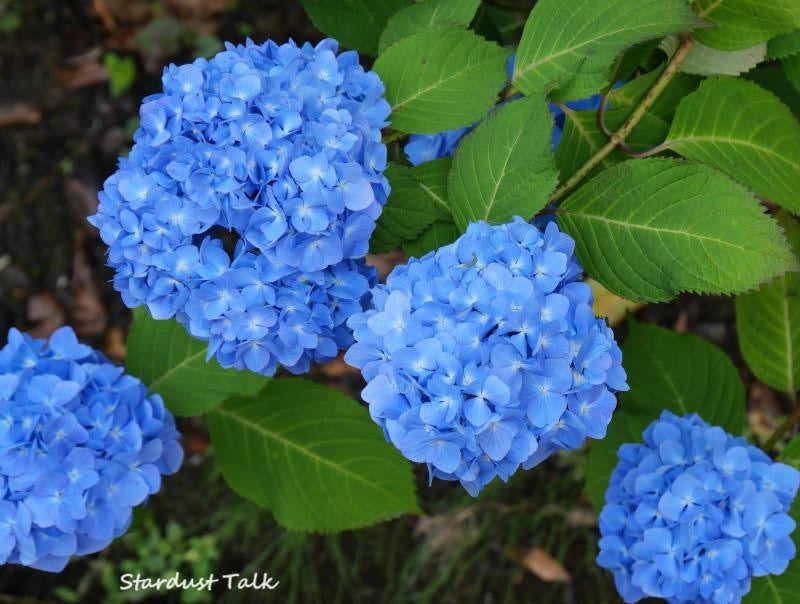
I love blue Hydrangeas.


Vibrant red Common coral-tree flowers and violet-colored Jacaranda shine in the summer sun.


Photographic summary of the botanical garden.


At home, the cake named Hydrangea reminded me of the Hydrangea garden.

Hydrangea Garden and a cake "Hydrangea"

Linked to Mosaic Monday

Monday, July 8, 2024

Dangerous heat waves during the Apricot Rains


Hot, hot, too hot, and too humid!
I don't feel like having a walk under this kind of weather, which saps my energy 
and makes me feel quite spent.

I found several unpublished photos taken during my trip to Kamikochi and Hida-Takayama 
on rainy days in 2011. 
Kamikochi is the plateau at the altitude of 1500 meters surrounded by so-called North Japan Alps, 
Hida Mountain Ranges.
People can enter from mid-April to mid-November; the rest of year, Kamikochi is in winter sleep.

I hope you can feel a little cooler while reading about the recent scorching heat.
 Kamikochi Walk (a post in 2011)


While unseasonal heat started as early as May this year, it was relatively cool
during the continuous wet weather of late June.
Then it has gotten scorching, boiling hot on the arrival of July despite Apricot Rains.
Intense heat of 35 degrees C or higher with high humidity, nearly 40C in some places, 
is life-threatening.
“Heat-stroke special alert” is to be issued based on WBGTwhich takes several variables 
into account; temperature, humidity, wind speed, sun angle, cloud cover and so on. 

Hida-Takayama City seen from our hotel

As I look at the photos of the old township of Hida-Takayama,
I'm reminded how the streets were vacant at around 9 a.m. back then
different from the recent bustling of tourists.


凸凹堂 (above) is a shop for hand-made accessories of natural stones, especially featuring 
blue colors of the deep sea.


Teashops; above and below.


Weather seems to have been becoming extreme year by year.
When it rains, it's torrential; when the sun shines, it’s dangerously hot.
During the Apricot Rains of late June, it often rained cats and dogs.


One day I went to the nearby park when the morning downpouring was eased.


The blades of grass glow with crystal-like raindrops.


Do you find peace in the rain?


Back home, Ajisai (Hydrangea) was showing off its radiance under the leaden skies.


This spider was the last-minute entrant before I came into the house.


The current heat wave will be stopped as the Apricot Rains is returning soon.
I look forward to walking in the rain.
I pray for no disastorous heat waves and devastaing rainfall.

Linked to Mosaic Monday

Saturday, June 22, 2024

紫陽花 Ajisai and 梅雨 Apricot Rains

How has the weather been recently?
It has been like this here in Kansai region; when it rains, it pours 
and when it's sunny, it's very hot for June.
The rainy season set in yesterday at last when we are usually right in the middle of it.
In the southern Okinawa and Amami Oshima, its end was declared the other day.

Our rainy season is called 梅雨, Apricot Rains, because it falls on the time
when 梅 Japanese apricots ripen.
As its poetic name suggests, there are many nice things during this season.


Ajisai, or Hydrangea, is the most popular flower of the season.
They don't come and go all at once like Sakura but last long almost all through
the Apricot Rains.


When Ajisai start blooming, they show shades of cream to green.
As they age, their colors deepen.


I like blue Ajisai above all.


When I walked along my favorite Ajisai lane , which partly runs parallel 
to Chokyu-ji Temple, I focused on blue flowers to photograph.

June 8th

The path, which connects the Tomio River and the Mayumi residential area,
 is nicely narrow and curving.


A couple of days later than that, I visited 般若寺 Hannya-ji Temple for Ajisai.
I prayed for no risk of torrential downpours.

June 11th

Hannya-ji is more famous for its cosmos flowers in autumn as is called "Cosmos Temple".
Summer cosmoses were mostlly over.


I have stopped by in June every year since I saw Ajisai Bowls for the first time 
three years ago.
One of the monks came up with the idea of Ajisai Bowl to make use of Ajisai flowers
 that are still beautiful after their prime time.


The round Ajisai flowers look beautiful from any angle in spherical glass container.
The temple has changed the way of displaying Ajisai Bowls every year.

The same Ajisai Bowl seen from the different angle.

I liked it when the bowls were placed among the greenery to reflect the surrounding colors.
They looked like planets as is reported here, Ajisai walk, joy of rainy season (2022)


There are many nice places to stroll through Ajisai in and around Nara City 
including temples, parks, streets, etc.
矢田寺 Yata-dera and 岩船寺 Gansen-ji Temples are famous as “Ajisai Temple”.


Linked to Mosaic Monday