Pages

Showing posts with label rice paddies. Show all posts

Tuesday, July 9, 2013

Nostalgic scenery of early summer at Asuka Village

When I took these pictures in late June right after the farmers finished planting rice seedlings to the paddies, it was relatively cool with rainfall on and off.  In two weeks, it got sweltering in heat as the rainy season came to an early end.
 
Hosokawa area
Terraced fields and paddies are common in the countries with vigorous slopes.  In Japan, where about 73 percent of land is mountainous with scattered plains and inter-mountain basins only about 25 percent, there are many places noted for the beautiful terraced paddies.  Asuka, Nara Prefecture, is one of them.  Terraces are farmed by hand. 

This is a vantage point overlooking the Hosokawa area.


There were a lot of terraced paddies throughout Japan, but it has become difficult to keep rice cultivation there because of the drastic drop and aging of agricultural population.  To keep the landscape and traditions, which have sustained generations for centuries,  some voluntary people have been working with the initiatives by the communities in recent years.


Frequent rainfall is needed by the farmers during the rice-planting time which falls on the start of the early smmer rainy season.  


I like to see the blue skies in the rice paddies filled with water.


Hosokawa area in the drizzle
Mosaic-like landscape of rice terraces would be a work of art created by farmers for the purpose of producing food.  The terraces blend in with the natural scenery and give visitors a great sense of peace and comfort. 


One of just another ordinary scenes between the paddies


The Asuka River flows through thousands of years.
The locals in the area lead a life that has changed little over the years.


Asuka is one of the most important spiritual and cultural assets of Japan.

See how it is so in autumn.
On a sunny autumn day at Inabuchi, Asuka Village
 Strolling around Asuka.


Monday, October 8, 2012

On a sunny autumn day at Inabuchi, Asuka village


Asuka was the capital of Japan as the home to Japan’s ruling imperial court at the end of the sixth century.  It was during this time when Japan absorbed  much of the culture and administrative methodology of China and Korea.  Many villagers of Asuka were from the Korean peninsula. The region is a small basin encircled by small misty mountains, hills, and the winding Asuka river flows the center of it.

 
In the land of farming, the water of the Asuka River was used for irrigation, while the occasional flooding brought rich, fertile agricultural soil. 


The water has flowed ceaselessly from the ancient times connecting the past with the present.


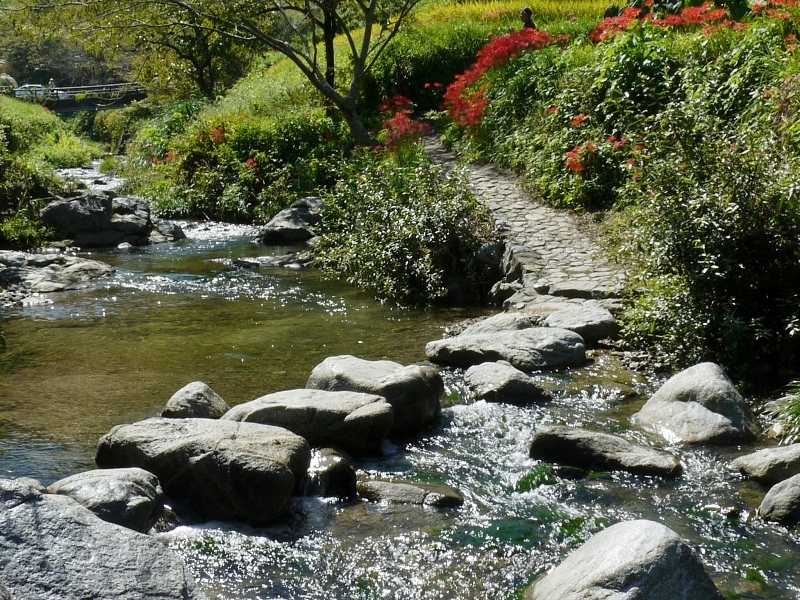
At the upper Asuka River in the Inabuchi district, there are stepping-stones which have been laid by the local people to cross the river since the ancient times.   Whenever the stones were washed away in flodding, new stones were replaced in a long history.


As a historical fact, 南淵請安, Minabuchi no Shoan, lived around there.  He was a monk studying abroad as a Japanese envoy to Sui and Tang dynasties China.  When he started a school on his return,  中大兄皇子 (Crown Prince Naka no Oe) and 中臣鎌足 (Nakatomi no Kamatari) learned Confucianism there.  It is thought that the two of them conspired to defeat the Soga clan, which "monopolized the position of 大臣 (Great Royal Chieftain) and was the first of many families to dominate the Imperial court by influencing the order of succession and government policy", on their way to Minabuchi.  The defeat of the Soga clan led to 大化の改新 (Taika Reforms, 645) which brought about greater centralization and enhancing the power of the imperial court.

Crown Prince Naka no Oe and Nakatomi no Katamari would have walked on the stepping-stones to see Minabuchi.
 
Inabuchi district is noted for terraced paddies.  The spread of beautiful terraced paddies is seen as the old heart of Japan.
 

The different scenic expression of the terraced paddies from season to season is one of the greatest attractions of the Asuka village.  In autumn, it is 彼岸花, Cluster amaryllis, or Lycoris radiata, on the footpats beween the paddies.


Ready for reaping.
 
All the Japanese Higanbana is triploid form.  “The triploid forms are sterile, and reproduce only vegetatively, via bulbs. The Japanese triploids are genetically uniform. It has been suggested that they were introduced into Japan from China along with rice cultivation.” (Wikipedia)   They are unable to produce seeds.  It is thought that some bulbs from China have spread throughout Japan by separating the bulbs.  Higanbana could have spread to all Japan from this Asuka village.


 This is one of some Manyo poems in which the stepping-stones of the Asuka appear.
 
                                                                        明日香川
明日も渡らむ
石橋の
遠き心は
思ほえぬかも
 
Authour unknown, 
万葉集 (Manyoshu Anthology, 8th century)  11-2701

Meaning:  I’ll cross the Asuka River by the stepping-stones to see you tomorrow again, like “asu (tomorrow)” of the name “Asu-ka”.   I’m alwlays thinking of you  and I don’t think we are separted like the stepping-stones.  (I love you so!)

In the Manyo poems, these stones often imply a (secret) date or emotional distance of two lovers.


Autumn of Asuka with more information about Higanbana:  Strolling around Asuka


Friday, April 20, 2012

April colors in Asuka Village

Asuka Village is dyed in pink, yellow, and fresh green in April.


Asuka is one of the places I feel connected to ancient times: the wind I feel on my skin would be the same wind blowing through time and space and the ceaseless flow of the Asuka River connects now to the past. The name Asuka conjures up images of ancient love stories and tragic legends.

 the Asuka River near the Asuka Bridge


Asuka was once the capital of Japan from the late 6th to the early 8th century.  Prior to Nara Period (710-784), wherever the reigning emperor had a palace became the capital.

Buddhism, which was imported from India via China and Korea, was foreign culture and revolutionary change of thought.  It was not only religion but also medicine, science, astronomy, and so on.  It was immigrants from China and Korea who settled in Asuka and led Japan to the great transformation in art, culture, and politics.  Asuka was also the stage for the bitter power struggles. 

around the Ishibutai Burial Mound

This place is outside the Ishibutai Burial Mound, one of Japan's largest burial mounds, which is said to be the tomb of Soga no Umako.  According to some elderly, there was no gate and no fences and they could freely approach to the exposed huge rocks which form the burial chamber's upper portion in the past.  The landscape of huge rocks lying in the vast field of wild flowers must have been awesome.


While most of the legacy of the Asuka Period is buried underground, many ancient burial mounds, ruins of ancient palaces, mysterious stone objects, and sites of temples that no longer stand as well as the several extant temples including the oldest Buddhism temple in Japan, are dotted on the gently rolling hills.


Asuka is noted for the rice terraces.  Rape blossoms and milk vetches bloom here and there till the rice seedlings are planted.

稲淵/Inabuchi district

bounded rice straw


This is one of a pair of sacred ropes hung across the upper Asuka River to receive the fortunes carried down from the upper stream.  Another sacred rope wards off the evil spirit believed to come from the down stream.


Tachibana-dera Temple
Tachibana-dera Temple is one of the several extant temples in Asuka and is believed to be the birthplace of  Prince Shotoku, a regent to the emperor and politician.  He looked to China for political and religious inspiration and succeeded in establishing a centralized government.  He was inspired by Confucian teachings, and taught "Harmony is the greatest of all the virtues.", which is still in the heart of many Japanese people.


the roof of  Tachibana-dera Temple


This is the three storied pagoda of Oka-dera Temple.


Can you spot the pagoda in the mountain?


Visitors can relax and unwind themselves just being in Asuka.  My husband and I didn't enter any temples or historical sites.  We just walked around the area leisurely and had homemade "bento", a box lunch, viewing the scenery and flowers in the soft breeze and sunshine.  Rental cycle and bus services are available.  If you are interested in autumn of Asuka, have a look at Strolling around Asuka.
A few days ago my mother got hospitalized for the pneumonia-like symptoms: yesterday her illness was diagnosed as infective endocarditis, potentially life-threatening one.  She is a green, old woman overcoming two plastic surgeries on her left thigh (at the age of 88) and then right thigh (at 90),   My siblings and I take turn being with her, praying for the best. 

Monday, July 25, 2011

At the crossroads

Sagi-ike Pond in Nara Park

Do you see something other than the clouds in the blue sky?

Afternoon moon in the blue sky, 
do you spot this out in the first photo?

I’ve believed we’ll find simple truth by looking up at the sky like “Sky-blue Flowers” or looking at the horizon of the immense sea.  Today I’m not talking about a poem but energy, energy from the sun.  It is inexhaustible source of energy.  Why did humans start getting energy by looking down inside the earth instead of looking up? 


The way to Yagyu from Nara City. What would become of these rice paddies if contaminated by the invisible nuclear substance?

Now that I've witnessed the enormity and severity of the risks and tormenting misery of Tohoku people associated with nuclear power generation,  I want nuclear-free future.  It will take a long time, however, once a goal is set up, people will be determined to do challenging tasks uncompromisingly.   People also will cooperate to go through power shortage in the transitional period as we are doing now.  Due to the destruction of the Fukushima nuclear plant and many offline nuclear reactors under the inspection, we are expected to save power by 10 to 15 percent to avoid massive blackout in spite of our notorious hot and humid summer.  People’s energy conservation efforts and companies’ in-house power supplies have been working well so far. (Knocking on wood..., as we still have a very hot month ahead.)  After all, the time is over when we can use power abundantly and now is the good chance to change our lifestyle to more natural way.

Summer green

Once the civilization has developed so far, is it impossible to change the course?   There is an idea to make the whole Japan a mega solar power generating factory eventually by decreasing dependence on nuclear power gradually.  I think it’s fascinating.  When the central government had no constructive idea, it was proposed by the president of Softbank Corp.  Osaka prefecture's governor supported the idea quickly and 35 prefecture's governors join the plan so far.  Prefectures offer land free and Softbank construct mega solar plants on it.  In the open space in each prefecture, there will be huge solar generators.

Some people criticize it as Mr. Son’s business strategy.  If people are critical, why don't they propose another constructive ideas of their own?  Some people propose that work of generation and distribution of power be divided, and some say only solar energy is risky because weather is uncertain.  Japan has a month-long rainy season.

According to yesterday's newspaper, The Sankei, Osaka prefecture announced that when solar panels are put on the roof of every house, building, school, etc. of Osaka prefecture, the amount of generated energy will be equivalent to the one by 5 nuclear reactors.  The governor plans to realize it with government subsidies, though with the introduction of new tax to make the budget.  


Central Kobe in 2011
The reconstruction of Kobe after devastating 1995 earthquake was realized
much faster than expected.

A minister said that decreasing nuclear power would be detrimental to the industrious development and we would not be wealthy any more.  I'd like to ask what is the role of the government: to make people rich, or to make people happy?  I'd like to be safe and sound always without "man-made" catastrophe.  Fortunately the renewable energy technologies have been growing and storage battery technologies are heating up.  By careful shifting from nuclear power to renewable power gradually, maybe we could become self sufficient in terms of energy in future.  I don't want this ends up wishful thinking.


Last but not least,  my thoughts and prayers are for the deceased, the bereaved, the injured, and all the Norwegian people.

- To learn more about our world, click on the picture of My World on the sidebar. -