 |
Large old mercantile buildings on Kobe Kaigan-dori Street of Route 2
Effect of "impressive art"
|
 |
| Sometime in late 1800's or early 1900's, image via here |
神戸旧居留地, Former Foreign Settlement of Kobe, was established as a place where foreigners (not all the foreigners but Europeans and Americans at first) could live and trade when the Port of Kobe opened according to the Ansei Treaties of Amity and Commerce (1858) concluded with the United States, Great Britain, Russia, Netherlands, and France, after long national isolation.
The settlement was designed by British civil engineers. 126 blocks in the district were sold to Western foreigners at auction. (The remaining building number is the block number.) The district spreads at the seaside between the east "Flower Road" and the west "Meriken Road". The current traffic road was a sandy beach back then.
After the foreign settlement was returned back to Japanese government in 1899, Japanese businessmen also used this district and it became the business center of Kobe.
With the start of World War II, most of the foreigners went back to their countries. In 1945, about 70 percent of the buildings in this settlement were destroyed by air raids.
After the war, modern buildings were built while the remaining original buildings got older. Until 1980’s, the district was simply old office streets with aged buildings, but in the late 1980’s civil movement to preserve the district got active, and besides, under the leadership of Daimaru Department Store, the mentality of the building owners changed to be conscious about “town-scape”, preserving dotted historical buildings to make a comprehensive nice and beautiful area.
In 1992, the district was designated as one of the top 100 beautiful city-scape in Japan. It is said to be one of the successful examples about the collaboration of civil movement and commercial capital.
After 1995 Great Hanshin Earthquake which collapsed more than 20 old buildings in this district, Kobe City government got involved actively in the restoration. The streets are protected not only through preservation but also with the understanding of how the landscape could be developed through the construction of new buildings.
 |
| Collapsed No. 15 Building, old American Consulate (1880), image via here |
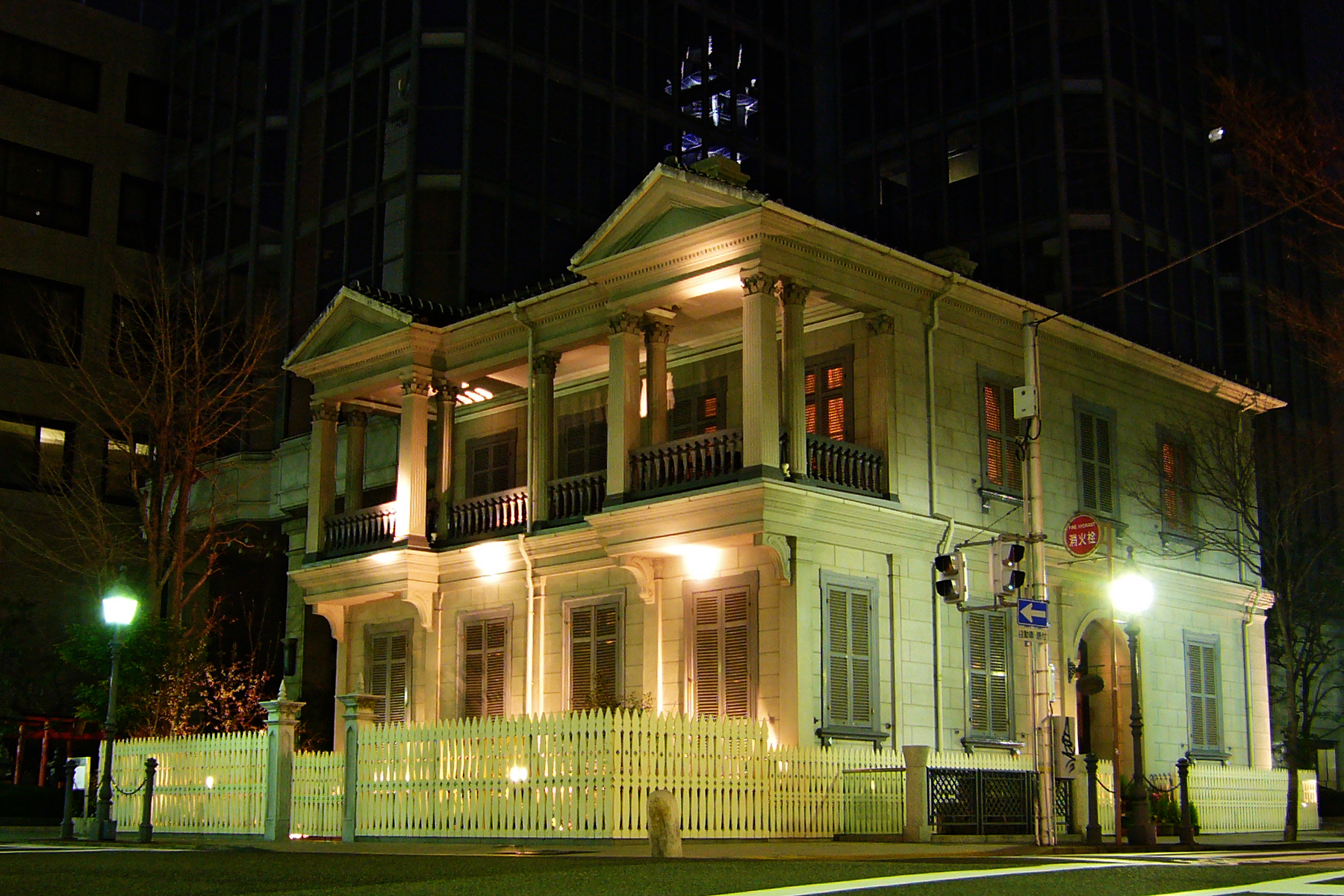 |
| Reconstructed No. 15 Building, image via here |
The building above, which was originally built in 1880 to house American Consulate, is the only building left from the Old Settlement days and is designated as an Important Cultural Property. It was destroyed completely during the 1995 earthquake, but was subsequently rebuilt using as much of the original materials as possible. It is used as a restaurant on the first floor and a cafe upstairs. I like it when historical assets are reused actively for practical various uses not only as museums.
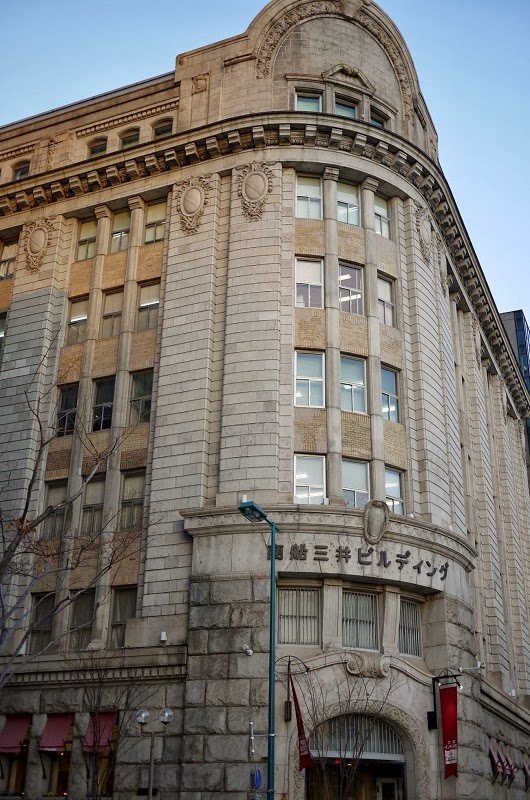
Let's see some of the European style buildings on the Kaigan-dori Street. Shosen-Mitsui Building built in 1922 would be the most impressive and magnificent building. It is one of the most representative retro architectures with meticulous relief carving, beautiful vertical lines like carved pillars, and stately masonry at the lower part. With reinforcement and partly renovation, it is used by Daimaru to display furniture and interior goods in a large scale.
 |
| Front entrance of Shosen-Mitsui Building |
 |
| other entrance |
Next to the Shosen-Mitsui Building (right) is Kaigan Building (left). It is a modern fifteen-story building including four-story classic building at the lower part.
This block used to be occupied by Kobe Branch of Mitsui-Bussan Co. The original building collapsed in 1995 Hanshin Earthquake and was reconstructed as an office building of which 1-4 floor was reconstructed in original style, using the original materials found in debris as much as possible.
 |
| Original door |
 |
| Tofu and Yuba Restaurant |
Across the street from Kaigan Building is former Kobe Branch of Nihon Yusen Co. After the first American Consulate moved to the other place, the building of former Nihon-Yusen Co. was built in 1918. It survived the earthquake because of the improved earthquake-resistance finished one year before. Grand Back for big and tall men carries on business there currently.
 |
| I wonder if this is Frank Lloyd Wright door? |
Right across the Kaigan-dori Street from the Grand Back is Meriken Pier.
Walking around this district reminds me of the history of this city. This is the place where foreigners tried to make their dream come true by trade and commerce after sailing across the Pacific to the far-east Japan. And besides, this city's history is a symbol of phoenix rising up. After the devastation of the war and another devastation by the earthquake fifty years later, Kobe City resurrected like a phoenix and is constantly evolving.
 |
| Two-tired Hanshin Expressway, Kaigan-dori Street, Former Foreign Settlement seen from Meriken Pier |


.jpg)
.jpg)


.jpg)


.jpg)


