Pages

Showing posts with label Asuka. Show all posts

Monday, September 13, 2021

Memories of summer, 2021


A windowpane covered with raindrops and green foliage outside

It's been a weird summer - life with COVID-19, extraordinary Olympics and Paralympics played in empty stadiums and arenas, and extreme weather difference. The Olympics must have been the hottest ever, but with its ending, there came unusual much cooler days with too much rain for the consecutive two weeks, and then with the start of the Paralympics, heat wave came back with vengeance.  During the Olympics, I felt like that I was choking in sauna. After that I wanted to send our rain to the areas suffering extreme heat and wild fires. The 1964 Tokyo Olympics was held in the cool, crisp air of October before the Games was overly commercialized. If the IOC values “diversity”, the various different climate of the host countries should be considered about the holding period of the events. 

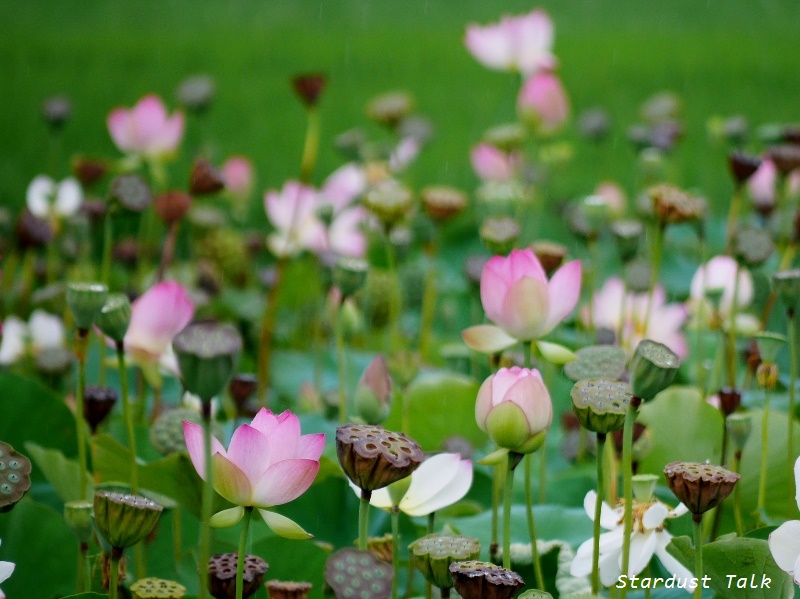
Two weeks of rainy days in high summer is the first thing I experienced in my life. While fearful of the violent rains, I liked the coolness, nonetheless, and enjoyed capturing the lovely scenes created by rain.


The Lotuses and a Heron were taken at the ancient Fujiwara Palace Ruins near Asuka Village.  The aqua plants looked dreamy and harmonious in each process of life under the leaden skies.


On our way back

The Paralympics ended about a week ago. The performances of the Olympians were so moving and inspiring, and still more the Paralympians’. How many times was I moved to tears?  I’m happy for the athletes that they could play to their full potentials  protected in the parallel world of the bubble.  I'm also grateful to the volunteers who practiced "hospitality" tirelessly on behalf of the citizens. Outside the bubble, COVID-19 case number recorded highest every passing day. 


I like myself best when I'm with my grandchildren.  Especially so, when I can't escape from  sadness and grimness of daily news worldwide. They returned to school late August.  Now that the declining trend of infection continues, school lunch started today.  A little over 50 percent of the 120,000,000 population finished full vaccination in my country.  Acquiring herd immunity is said to be difficult regarding RNA viruses like corona. Can we catch our breath, or as is often the case, will the loosened tension for more freedom trigger another big wave? 

Linked to Mosaic Monday

Monday, May 4, 2020

Recalling the travels to Asuka

The whole world is a series of miracles, but we're so used to them 
we call them ordinary things.”
 (Hans Christian Andersen)

The south side of Asuka from the Amakashi Hill

Each day is made of something special which we take for granted.
We've missed many special, important things due to the new coronavirus, 
but still each day is a special occasion I learn something new. 

I believe in human miracles which have overcome and revived from the shattered community 
by wars, natural disasters, or plagues throughout history.
Now I’m amazed with such a mass behavioral change
 that majority of people change habits drastically without strict orders
but merely requests from the prefecture and central government leaders.
(Mandatory order is impossible under the Constitution.)
We won’t regret doing responsible action but will regret that we don't do it sooner and thoroughly.
That attitude can flatten the curve of infections so that our health care workers work as safely
and efficiently as possible, and save time for the vaccine to be invented as well.

 Chinese Milk Vetches

The warmth like early summer after the cold April is tempting for a trip,
but I'll recall my past travels to Asuka where I can feel ancient miracles and mysteries.
Asuka is a small village in the countryside, birthplace of Japanese civilization,
where Buddhism first flourished after its entry in 6th Century.
Travelling around rolling hills and green fields of Asuka is soothing.


At the Amakashi hill, after a little prayer to the stone Buddhist statues, ....


... my husband and I walked up to the observatory (148m) in the dappled shadows
and the fresh verdure of the late April, 2016.


Looking closer, you surely find lovely critters here and there.


A village looked down from the north side of the hill

It is believed that the residence of Soga Emishi and his son Soga Iruka 
was located on the hill. 
The Soga clan were the dominant political power during most of 
the former part of Asuka Period (528-710). 
When Soga Iruka was assassinated in 645 (Isshi Incident), 
the clan's political domination came to an end 
and the Japanese political landscape changed dramatically. 
The former site of the imperial palace, where the assassination took place, 
was visible from the hill. 
It is now buried under the rice paddies.


The stage of ancient loves, power struggles, and tragic legends

During the Sakura season in the beginning of April, 2019,
 golden yellow rape blossoms and pale pink cherry blossoms compliment each other
at the former site of Fujiwara Palace (694-710).


On saying "see you next year" to cherry blossoms and to Asuka,
how could I imagine the current state of the world
in spite of the knowledge that all the realms of being are uncertain?


The Dawn of Japan
Women in the Asuka period (2)
The Empress who made Japan - Empress Jito
Historical facts in story form with related sites
(1)Suiko, Japan's first empress

More posts about Asuka, here.


Monday, October 9, 2017

Scarecrow Contest at the Rice Terraces

 Scarecrow contest is held every year at Inabuchi district of Asuka village 
when rice paddies are turning gold.
Inabuchi is noted for the grand rice terraces, which are farmed by hand, 
spreading on the rolling hills.


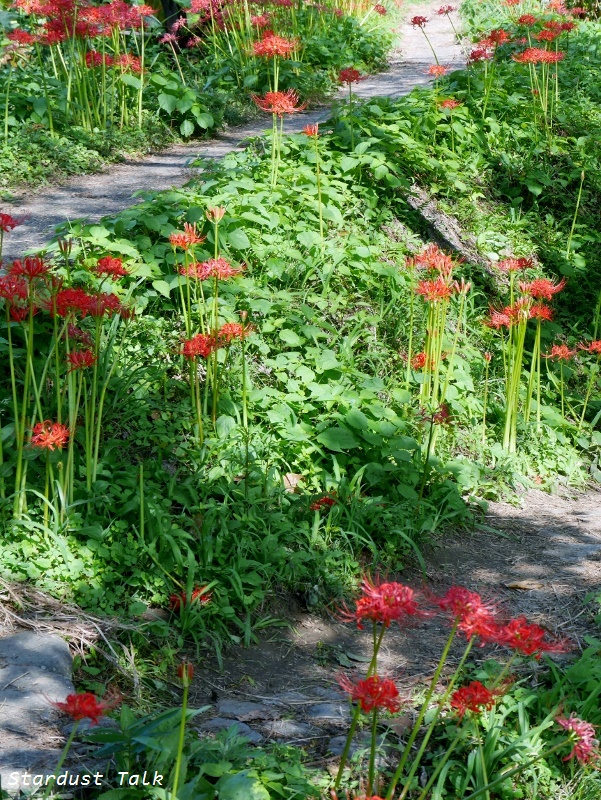
At this time of year, rice terraces are edged by the brilliant red flowers.
They are Lycoris radiate, "higanbana" in Japanese, for they are the flowers (hana) 
which usually bloom around the autumn equinox day (higan).  


Walking along the path between the paddies,
you'll meet many various scarecrows of any nationality, young and old.
Hello, farmers and cat musician!


I hadn't thought I'd encounter a Mexican or Sheriff Woody at such a place.


This guy's eyebrows, eyes, nose, and mouth are drawn with some of Japanese alphabets "へのへのもへ".


These scarecrows remind me of fairytale or children's song.


Charming ladies!
They look more like life-size dolls than scarecrows.


Asuka was the capital of Japan at the end of the sixth century. 
Most of its legacy remains buried underground
while some of the ancient burial mounds and temples, ruins of ancient structures,
mysterious stone objects,  and other historic sites are open to public.


Asuka is one of the places I feel connected to the ancient times.
The exotic flower takes my thoughts to the time
when it was first imported from China.


I hope you enjoyed walking with me in the warm sunshine.
Which scarecrow would you like to vote for?


Incidentally, my youngest grandchild Y enjoyed his first Sports Day at his kindergarten yesterday.
Three-year-olds were simply cute, running or dancing in a fancy costume.
Five-year-olds amazed me with their terrific marching band and coordinated group gymnastics
as I had been so in F’s kindergarten.
The three-year-olds will change dramatically in a few years.


Friday, September 16, 2016

Changing floral-scape at the ancient Fujiwara-kyo

Early autumn


Around the remains of the old Yakushi-ji Temple in the Fujiwara-kyo (694-710), 
the ancient Imperial Capital of Japan,
mass blooms of Eichhornia crassipes (water hyacinth) are seen from mid-August to late September.

The moody weather with heavy rain clouds and strong wind was a perfect setting
to remind me of the mystery
why a great scale of Fujiwara-kyo was abandoned after only sixteen years
and why the all the structures were burnt down to ashes on year later
 the capital was moved to Heijyo-kyo in the current Nara City.


The pastel mauve fairies at the waterfront.


When patches of blue sky appeared, light shimmered both on the flowers and water.


Fujiwara-kyo site is located at the laid-back countryside 
in the circle of three small hill-like mountains of Yamato province, 
Mt. Kagu, Mt. Miminashi, and Mt. Unebi.


Mt. Unebi in the west
Fujiwara-kyo must have been the total grandeur as was revealed by the recent investigation; 
“it covered an area of roughly 5 km and was surrounded by walls roughly 5 m high. 
Each of the four walls had three gates; Suzakumon, the main gate, stood at the center of the south wall. 
The Daigokuden (Emperor's Audience Hall) and other palace buildings were the first palace structures 
in Japan to have a tile roof in the Chinese style.”

Archaeological excavations was started in 1934. 
The remains of various offices as well as nearly 10,000 wooden tablets 
inscribed with Chinese characters have been discovered.

Summer
July 21
From July to mid-August, prior to the blooms of water hyacinth, Lotus flowers bloom 
around the remains of the Imperial Audience Hall. 
As the flower of Buddha’s Pure Land, they look consoling the souls 
sleeping underground which turned to the nature.


Both flowers and leaves rise up from the muddy water to the light.


In 1951 Japanese palae-botanist Dr. Oga discovered three lotus seeds during an archaeological dig.
The seeds turned out to be 2000 years old. 
Dr. Oga germinated the remaining seed to flower in 1952. 
The lotus was named after Dr. Oga and is now widespread throughout Japan. 
One of eleven species flowering at this place is Oga lotus, descendents from the ancient time.


Some hundred meters north beyond the Lotus area lies flowering meadow of yellow summer cosmos.

Mt. Miminashi in the north
Different flowers create different atmosphere.
Bright yellows and oranges look able to counter the scorching summer sun.


With a leaf of "Kudzu", or arrowroot.


The contrast of light and shadow

Mornings and evenings have gotten cooler but it's still sultry in the daytime 
with the hottest temperature about 30 degrees.
As the floral carpet changes with the changing seasons,
 the area will be covered with shades of pink of autumn cosmoses soon.