Pages

Showing posts with label lotus flowers. Show all posts

Tuesday, July 11, 2023

In the sultry air under the grey skies


About six weeks have passed since Apricot Rains set in my Kansai region in May 29th. 梅雨Tsuyu, Apricot Rains, is called so as the rainy season coincides with the ripening of 梅Ume, or Japanese apricot. The weather is mostly grey with overcast, drizzle to torrential rain, occasional rain storm with or without thunder and lightning. When blue skies appear, it's unbearably humid. People feel sticky and uncomfortable because of slowed down evaporation. I feel lethargic at times but fortunately not "under the weather." I like to go out to capture the special atmosphere of this season.


Nature looks lusher with the deep green hues and scenery shines in a little darker color nuance.


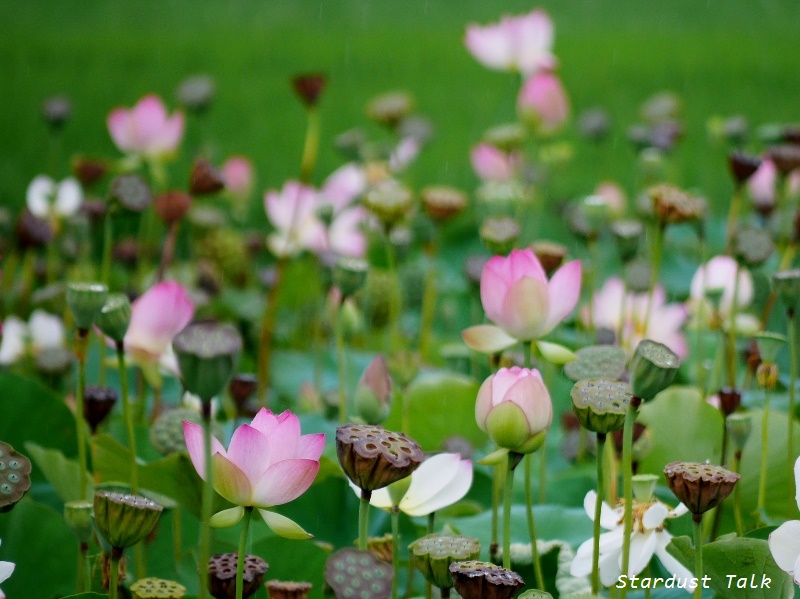
Lotus flowers, hydrangeas, bell flowers or water lilies, add pretty colors.


Under the flowers and pads, water surface looks enchanting.


The blue hydrangeas around the pond are fragmentally glimpsed on the surface of water lily pond.


A faint breeze over the pond and a ripple of hope.


There is a silver lining to the rain clouds.

(See more nice things during the Apricot Rains; 
and all the other posts labelled as "rainy season", here.)


With the recent rainfall pattern change, the record of hourly rainfall has been broken every year causing more flooding and landslide. When Apricot Rains is over in a week or so, sizzling, scorching, and swealtering summer comes, though some other regions are already attacked by the dangerous heat.

I'll slow down to cope with the climate as usual in summer. 
See you in September.

Linked to Mosaic Monday

Saturday, July 9, 2022

Like a Lotus flower

I feel cool breeze wafting from the window by my side as I write this post.
I also hear the thunder rolling after raining cats and dogs.
Only rain can soften the heat.


As season progresses into mid-summer, Hydrangeas are withering while Lotuses have come into bloom.
Lotuses grow in muddy water, stretch straight to the sunlight, and bloom graceful untainted by the mud.
In some Buddhist schools, it is thought that each stage of growth of Lotus symbolizes 
each step to enlightenment. 


In late June, we suffered the record swealtering heat wave for June since 1875.
Some of you would have suffered from heat wave, but people living in less humid places
 wouldn't know how unberable and deadly the heat wave with high humidity can be.
Sweats don't dissipate and there's no escape except for air conditioning.
We were advised to use it despite calls for energy saving due to looming power shortage.


Toshodai-ji Temple

As you might know, our ex-PM Abe was shot to death during the election campaign yesterday.
It happeded right at the place I often walk by.
In my country, owing gun is extremely difficult and gun crime is very rare.  
A man killed Abe with homemade gun not from political belief but personal grudge against a religious cult.
 To another NGO organization of it, Abe once sent a supporting video message.
which could have caused misunderstanding about his relation to it. (Added on July 13th)
I didn't agree with Abe for everything, but his dedication to the country and the world 
for peace keeping is sorely missed (tears).

In the rain

Nothing remanis the same.
The terrible heat wave doesn't last so long, but the frequency and intensity have increased.
There are appauling absurdity with no prospect of end.
I'll keep my fingers crossed; merky situation in all the different kinds and degrees end soon 
through cooperation toward the light of the sun and no one lose humanity.
 "An eye to an eye makes the whole world blind." (Mahatma Gandhi)


It's been raining on and off like usual early July and I could catch my breath
before tackling again with our usual notorious scorching and muggy midsummer.
It's time for me to slow down to enjoy the idleness of the season apart from this laptop.
See you in September, Friends!

More details about Lotus flowers, The life of  the Sacred Lotus flowers 

Linked to Mosaic Monday

Monday, September 13, 2021

Memories of summer, 2021


A windowpane covered with raindrops and green foliage outside

It's been a weird summer - life with COVID-19, extraordinary Olympics and Paralympics played in empty stadiums and arenas, and extreme weather difference. The Olympics must have been the hottest ever, but with its ending, there came unusual much cooler days with too much rain for the consecutive two weeks, and then with the start of the Paralympics, heat wave came back with vengeance.  During the Olympics, I felt like that I was choking in sauna. After that I wanted to send our rain to the areas suffering extreme heat and wild fires. The 1964 Tokyo Olympics was held in the cool, crisp air of October before the Games was overly commercialized. If the IOC values “diversity”, the various different climate of the host countries should be considered about the holding period of the events. 

Two weeks of rainy days in high summer is the first thing I experienced in my life. While fearful of the violent rains, I liked the coolness, nonetheless, and enjoyed capturing the lovely scenes created by rain.


The Lotuses and a Heron were taken at the ancient Fujiwara Palace Ruins near Asuka Village.  The aqua plants looked dreamy and harmonious in each process of life under the leaden skies.


On our way back

The Paralympics ended about a week ago. The performances of the Olympians were so moving and inspiring, and still more the Paralympians’. How many times was I moved to tears?  I’m happy for the athletes that they could play to their full potentials  protected in the parallel world of the bubble.  I'm also grateful to the volunteers who practiced "hospitality" tirelessly on behalf of the citizens. Outside the bubble, COVID-19 case number recorded highest every passing day. 


I like myself best when I'm with my grandchildren.  Especially so, when I can't escape from  sadness and grimness of daily news worldwide. They returned to school late August.  Now that the declining trend of infection continues, school lunch started today.  A little over 50 percent of the 120,000,000 population finished full vaccination in my country.  Acquiring herd immunity is said to be difficult regarding RNA viruses like corona. Can we catch our breath, or as is often the case, will the loosened tension for more freedom trigger another big wave? 

Linked to Mosaic Monday

Monday, July 17, 2017

The life of the Sacred Lotus flowers

Sacred Lotus, or Nelumbo nucifera, is one of the oldest plants on the earth.
It is said to have adopted water as a habitat about 140-million years ago.

Hokongo-in Temple, of which history starts in 742,
is famous for the lotus flowers in summer.


From the muddy water, Lotuses stretch upward to the sunlight, 
and bloom flowers untainted by the mud.


The flower is ephemeral. Its longevity is only four days.
 Flower bud is very tight and pointy at first .


The first day,
a bud unfurls 3-4 centimeters and then closes maintaining upward pointing bud.


The second day,
the flower bud begins to mature, unfurling into a chalice-like multi-petaled blossom 
with a central head pod.


The third day,
the flower opens to its maximum.


The fourth day,
 the fully opened blossom falls downward, away from the central cupule. 
All the petals drop till noon.
When the petals drop, the central pod enlarges and ripens.


Petals on the verge of falling apart

The leaves are also attractive.
The veins are radiating out from the center to the margins.
The shape  has similar look to the flowers' chalice-like form.
The cylindrical stalks stretching from the bottom of the water high into the air
make aqua forest.


At the Water Garden, there are light, ripples, reflections, shadows, and carps.


Carps look shading themselves from the scorching sun under a water lily pad.


This is a roof-tile displayed in the garden.
The character , swastika, is a symbol of a temple in Japan. 
It is an ancient religious symbol, a sacred and auspicious symbol in Hinduism, Buddhism, and Jainism, 
dating back to before the 2nd century BC.


There are so many to see in this temple;
hydrangeas, lilies, mushrooms, and moss...., to name a few.


Though there is no official report of the end of the rainy season,
it has been sizzling, scorching, and sweltering hot.
Today high temperature warning is issued in some regions.
I'll have a summer break in blogging and commenting
after I visit around you.
Wish you a nice, healthy, and fruitful summer.
See you in September.

During the Golden Week in May

Mosaic Monday
Our World Tuesday

Friday, September 16, 2016

Changing floral-scape at the ancient Fujiwara-kyo

Early autumn


Around the remains of the old Yakushi-ji Temple in the Fujiwara-kyo (694-710), 
the ancient Imperial Capital of Japan,
mass blooms of Eichhornia crassipes (water hyacinth) are seen from mid-August to late September.

The moody weather with heavy rain clouds and strong wind was a perfect setting
to remind me of the mystery
why a great scale of Fujiwara-kyo was abandoned after only sixteen years
and why the all the structures were burnt down to ashes on year later
 the capital was moved to Heijyo-kyo in the current Nara City.


The pastel mauve fairies at the waterfront.


When patches of blue sky appeared, light shimmered both on the flowers and water.


Fujiwara-kyo site is located at the laid-back countryside 
in the circle of three small hill-like mountains of Yamato province, 
Mt. Kagu, Mt. Miminashi, and Mt. Unebi.


Mt. Unebi in the west
Fujiwara-kyo must have been the total grandeur as was revealed by the recent investigation; 
“it covered an area of roughly 5 km and was surrounded by walls roughly 5 m high. 
Each of the four walls had three gates; Suzakumon, the main gate, stood at the center of the south wall. 
The Daigokuden (Emperor's Audience Hall) and other palace buildings were the first palace structures 
in Japan to have a tile roof in the Chinese style.”

Archaeological excavations was started in 1934. 
The remains of various offices as well as nearly 10,000 wooden tablets 
inscribed with Chinese characters have been discovered.

Summer
July 21
From July to mid-August, prior to the blooms of water hyacinth, Lotus flowers bloom 
around the remains of the Imperial Audience Hall. 
As the flower of Buddha’s Pure Land, they look consoling the souls 
sleeping underground which turned to the nature.


Both flowers and leaves rise up from the muddy water to the light.


In 1951 Japanese palae-botanist Dr. Oga discovered three lotus seeds during an archaeological dig.
The seeds turned out to be 2000 years old. 
Dr. Oga germinated the remaining seed to flower in 1952. 
The lotus was named after Dr. Oga and is now widespread throughout Japan. 
One of eleven species flowering at this place is Oga lotus, descendents from the ancient time.


Some hundred meters north beyond the Lotus area lies flowering meadow of yellow summer cosmos.

Mt. Miminashi in the north
Different flowers create different atmosphere.
Bright yellows and oranges look able to counter the scorching summer sun.


With a leaf of "Kudzu", or arrowroot.


The contrast of light and shadow

Mornings and evenings have gotten cooler but it's still sultry in the daytime 
with the hottest temperature about 30 degrees.
As the floral carpet changes with the changing seasons,
 the area will be covered with shades of pink of autumn cosmoses soon.