Pages

Showing posts with label countryside. Show all posts

Monday, October 25, 2021

Cosmos flower viewing in and around Nara City

Autumn has crept in through gradual cooling and changing.
After various subtle signs of autumn since late August.
 full blooming cosmos flowers here and there tell me, "It's autumn at last!"
Cosmos is written 秋桜 meaning "autumn sakura/cherry blossoms".
The waving shades of cherry pink in the breeze means full arrival of autumn to me.

Yagyu Village


In the morning of one hot summer-like day in mid-October, my husband parked our car
at the roadside along the cosmos fields in Yagyu Village, the outskirt of Nara City.
I think we were there 10 years ago, too, though the scale was much smaller this year.


We stopped by Hannya-ji Temple on our way back from Yagyu.
Hannna-ji Temple is called "Cosmos Temple" for its autumn cosmoses
and many other flowers attract people from season to season.
It was so hot and the mid-day sunlight was dazzling different from 
the crisp air and blue autumnal skies of the time when I visited in 2017,

Hannya-ji Temple

There were artistic display of cosmos flowers like that of hydrangeas and 
summer cosmoses in June this year. 


I like bokeh in photography. Especially light bokeh is fantastic!
Have you known that the etymology of bokeh is Japanese word 
"惚け/boke (noun)" meaning "being blur or senile"?
I'd like to think clearly and take care of myself as long as possible.
I wonder how I can "bokeru (verb)" gracefully without causing troubles.


In one late afternoon, I was at the cosmos fields around the Hoki-ji Temple, Ikaruga.
It was mostly overcast, not with the colorful sunset like Cosmos fields before sunset
or like the blessing of blue skies like Earth laughs in cosmos flowers at Ikaruga.

Three-storied Pagoda (National Treasure) and the cosmos flowers in the fallow paddies surrounding it.

Regardless of the weather, the wispy flowers always look dreamy.


The next day, temperature dropped by 10 degrees 
terminating the persistent abnormal heat of October.
Autumn has accelerated to progress toward the final blaze of lives of leaves.

Linked to Mosaic Monday

Monday, October 5, 2020

Placid fields of Soba Buckwheat flowers


White flowers of soba buckwheat bloom throughout fields mid-to-late September 

at Kasa Mountain, Sakurai City, about one and a half hours drive from my home.


The spreading white and shades of green carpets were punctuated at their margins

with pinks, purples, or yellows under the blue skies dotted with thick clouds.


Cool places at high altitude and arid soil is perfect for growing buckwheat. 

Kasa relatively located in south, People of Kasa have cultivated buckwheat by sowing late in season 

so that flowers bloom in cooler weather.

As they grow and ripen rapidly, the seeds sown in late August bloom in mid-September.

The flowers turn into grain-like-seeds, which are ground into flour early November.


Buckwheat is highly nutritious grains. 

They maintain good health of capillaries and blood vessels, keep our body resistant to infection, 

and prevent oxidation of vitamin C inside our body. 

They are mainly eaten as "soba" noodle and used for crepes, pancakes, or cookies as well.

The gluten-free buckwheat is substitute for those who have allergy to wheat flour.


Mass of white flowers and heart-shaped leaves were swaying in cool, crisp breeze -

isn't it picture-perfect?


 There are also red soba buckwheat flowers. Here.

Linked to Mosaic Monday

Monday, May 4, 2020

Recalling the travels to Asuka

The whole world is a series of miracles, but we're so used to them 
we call them ordinary things.”
 (Hans Christian Andersen)

The south side of Asuka from the Amakashi Hill

Each day is made of something special which we take for granted.
We've missed many special, important things due to the new coronavirus, 
but still each day is a special occasion I learn something new. 

I believe in human miracles which have overcome and revived from the shattered community 
by wars, natural disasters, or plagues throughout history.
Now I’m amazed with such a mass behavioral change
 that majority of people change habits drastically without strict orders
but merely requests from the prefecture and central government leaders.
(Mandatory order is impossible under the Constitution.)
We won’t regret doing responsible action but will regret that we don't do it sooner and thoroughly.
That attitude can flatten the curve of infections so that our health care workers work as safely
and efficiently as possible, and save time for the vaccine to be invented as well.

 Chinese Milk Vetches

The warmth like early summer after the cold April is tempting for a trip,
but I'll recall my past travels to Asuka where I can feel ancient miracles and mysteries.
Asuka is a small village in the countryside, birthplace of Japanese civilization,
where Buddhism first flourished after its entry in 6th Century.
Travelling around rolling hills and green fields of Asuka is soothing.


At the Amakashi hill, after a little prayer to the stone Buddhist statues, ....


... my husband and I walked up to the observatory (148m) in the dappled shadows
and the fresh verdure of the late April, 2016.


Looking closer, you surely find lovely critters here and there.


A village looked down from the north side of the hill

It is believed that the residence of Soga Emishi and his son Soga Iruka 
was located on the hill. 
The Soga clan were the dominant political power during most of 
the former part of Asuka Period (528-710). 
When Soga Iruka was assassinated in 645 (Isshi Incident), 
the clan's political domination came to an end 
and the Japanese political landscape changed dramatically. 
The former site of the imperial palace, where the assassination took place, 
was visible from the hill. 
It is now buried under the rice paddies.


The stage of ancient loves, power struggles, and tragic legends

During the Sakura season in the beginning of April, 2019,
 golden yellow rape blossoms and pale pink cherry blossoms compliment each other
at the former site of Fujiwara Palace (694-710).


On saying "see you next year" to cherry blossoms and to Asuka,
how could I imagine the current state of the world
in spite of the knowledge that all the realms of being are uncertain?


The Dawn of Japan
Women in the Asuka period (2)
The Empress who made Japan - Empress Jito
Historical facts in story form with related sites
(1)Suiko, Japan's first empress

More posts about Asuka, here.


Monday, October 9, 2017

Scarecrow Contest at the Rice Terraces

 Scarecrow contest is held every year at Inabuchi district of Asuka village 
when rice paddies are turning gold.
Inabuchi is noted for the grand rice terraces, which are farmed by hand, 
spreading on the rolling hills.


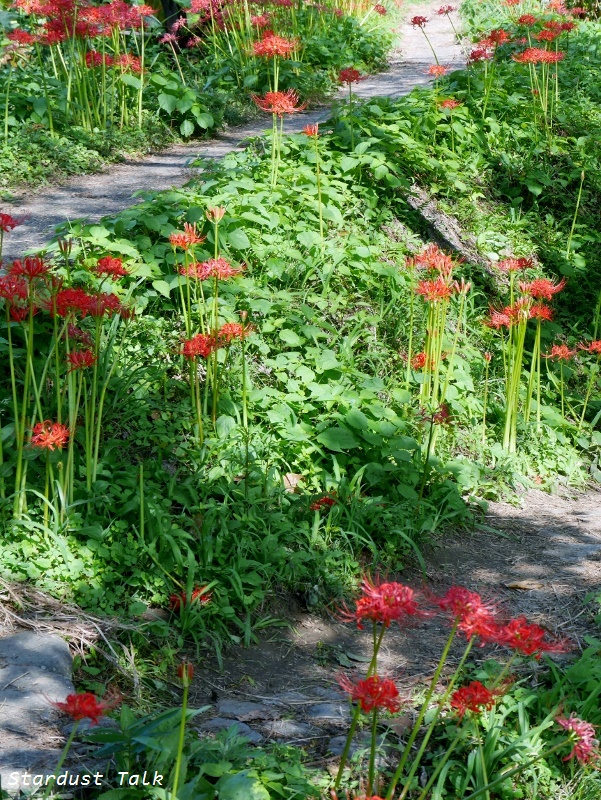
At this time of year, rice terraces are edged by the brilliant red flowers.
They are Lycoris radiate, "higanbana" in Japanese, for they are the flowers (hana) 
which usually bloom around the autumn equinox day (higan).  


Walking along the path between the paddies,
you'll meet many various scarecrows of any nationality, young and old.
Hello, farmers and cat musician!


I hadn't thought I'd encounter a Mexican or Sheriff Woody at such a place.


This guy's eyebrows, eyes, nose, and mouth are drawn with some of Japanese alphabets "へのへのもへ".


These scarecrows remind me of fairytale or children's song.


Charming ladies!
They look more like life-size dolls than scarecrows.


Asuka was the capital of Japan at the end of the sixth century. 
Most of its legacy remains buried underground
while some of the ancient burial mounds and temples, ruins of ancient structures,
mysterious stone objects,  and other historic sites are open to public.


Asuka is one of the places I feel connected to the ancient times.
The exotic flower takes my thoughts to the time
when it was first imported from China.


I hope you enjoyed walking with me in the warm sunshine.
Which scarecrow would you like to vote for?


Incidentally, my youngest grandchild Y enjoyed his first Sports Day at his kindergarten yesterday.
Three-year-olds were simply cute, running or dancing in a fancy costume.
Five-year-olds amazed me with their terrific marching band and coordinated group gymnastics
as I had been so in F’s kindergarten.
The three-year-olds will change dramatically in a few years.


Monday, December 5, 2011

A picturesque thatched houses hamlet, Kita-mura, Kyoto Pref.

Miyama-cho is nested in “Kyoto’s roof”, the Kitayama Mountains of northern Kyoto Prefecture.  Along the Yura River, there are several villages with traditional Kayabuki-yane (thatched-roof) farmhouses.

Kitamura Village with the mist-hung mountains of Kitayama cedars and deciduous trees
under the overcast sky


Kita-mura is one of those villages, a small hamlet, with cluster of some 50 farmhouses including 38 thatched-roof houses and a population of about 100.  The village was designated as an Important Traditional Architectural Preservation Area (重要伝統的建造物群保存地区) in 1994.


The steep rafter roofs are called “Gassho-dukuri” as known in Shirakawa-go and Gokayama, the World Heritage site.  “The Gassho-zukuri, ‘prayer-hands construction’ style is characterized by the thatched and steeply slanting roof resembling two hand joined in prayer.  The design is exceptionally strong and, in combination with the unique properties of the thatching, allow the houses to withstand and shed the weight of the region’s heavy snowfalls in winter.”  Miyama-cho is buried in the snow in winter.


A pair of kites (鳶) were taking the roof top as their vantage point.  Don't they look like ornamental tile "shibi"?   "Shibi" is a mythological bird believed to bring in rain  and drive away the evil spirits and is set on the both ends of top roofridge as a charm to protect the wooden structure from the fires.  Interestingly it is written with the Chinese Characters as 鳶尾 meaning "kite and tail". 


recently rethatched roofs

Maintenance of the roofs is a hard thing.  “Kaya” means all the grass reeds which are used for thatching like pampas grasses, sedges, and the likes.  Thatched roofs must be re-thatched regularly, once in five to ten years,  and the process is very time-consuming.   Reeds, which are harvested from autumn to winter, must be dried till next April and then are used for thatching.  Recently the durability of the thatched roofs has gotten much shorter due to weaker material grasses caused by the multiple reasons like polluted rain, change of soil, weather change, and so on.  And besides,  there are few experienced thatchers.  A new worker requires several years of practice before he can create a long-lasting, waterproof roofs. The local government has been subsidizing the costs of re-thatching the roofs.   Average cost is six million yen equivalent to about 45,000 US dollars at the latest exchange rate.

old thickly moss-covered roof


Another big problem about this hamlet is that this is a "semi marginal hamlet (準限界集落)", a rarely viable community due to aging and depopulation.  "Marginal hamlet" is the one of which 50% of the population is aged over 65.  People worried about the hamlet on the verge of extinction in the near future stood up and worked hard together to make it a viable community.  After the resignation as an Important Traditional Architectural Preservation Area in 1994,  public attention changed the elderly residents' sentiments.  They came to have more attachments to their old houses and got more pride and confidence in their environment which could make people feel at ease.  They have made efforts to keep the village paths and their houses in good shape and open, not overly so but reasonably, for the tourists.


The red color of the Pyracantha fruits is eye-catching in the muted colored landscape.

A few of persimmons are left for birds.


むらさきほおずき/purple Chinese lantern plant


The houses stand in peace and harmony with the surrounding nature.  Seeing from many tourist walking into the area and large buses parking on the opposite side of the road, I suspected that residents' lives were not so peaceful as they used to be, but they seem to live quite positively about the tourism.  Probably more well-behaved tourists or people who move into this place could sustain this picturesque hamlet.


colored leaves seen through Kitayama cedars

After leaving Kitamura, my husband and I drove along the Yura River and had a late homemade lunch overlooking the stream.  It takes about three and a half hours by car from our house in Nara City, so we made an early start at 7:00 a.m.


One day trip is possible from Kyoto City, but how about an overnight trip to taste well the place where spring is heralded by budding Japanese parsley, summer by the flicker of fireflies, autumn by colored leaves, and winter by a blanket of white snow?  Tourists will enjoy hiking in the Ashiu Forest or along the river, kayaking on the river, or camping.  As seasonal delicacies, there are "tsumikusa ryori" (wild young vegetables) for spring, sweet fish for summer, matsutake mushroom for autumn, and "botan nabe" (wild boar meat stew) for winter.


- To see more about our world, click on the icon of Our World on the sidebar. -