Pages

Showing posts with label art. Show all posts

Monday, February 9, 2026

Carried away from the woes of life in the floating world

The powerful winter pressure pattern over the weeks brought heavy snowfall across large parts of the country.
I've been chilled to the bone while the highest temperture has been hovering below 5 degrees C here in Nara.
One of the coldest days this season, I spent a pleasant time at the exhibition held at Grand Front Osaka,
UKIYOE IMMERSIVE ART - The floating world of Japan.

 
浮世絵 Ukiyo-e is paintings and woodblock prints that depict the daily life and entertainment of people 
during the Edo period (1603-1867).

"Ukiyo" is originally the word 憂き世 which means “the world to worry about”. 
Since the Heian period (794-1191), it has been used to express a pessimistic view of life based on 
the Buddhist concept of "impermanence".
People worry about hard, painful, sad, or unsettling situation in this earthly world.

During the Edo period, as townspeople gained economic power, their mindset ​​changed to a positive one
 to get through difficult reality with enjoyment.
The word “Ukiyo” got new Chinese Character “浮き世”.
浮かれる/Ukareru is a verb meaning "to get carried away" or "to get too excited."
浮き世 Ukiyo is a world where people pursue fleeting, yet exhilarating pleasure. 

Ukiyo-e was a representative pop culture that was deeply loved by the common people of the Edo period.
The vibrant, colorful prints were affordable to the general public.
It is said one print cost no more than a bowl of noodles. 
They were like “social media” or magazines in that time.

 I passed through Ukiyo-e Spaces to immerse myself in each theme, 藍, 跳, 麗, 彩, 豪, and 雅.


- 藍 AI, Indigo, or Japan Blue -

The contrast between nature's power and serene, quiet stability of Mt. Fuji from unexpected perspectives


 Shades of indigo is one of the representative colors of Ukiyoe, captured in the fleeting appearance 
of the sea water or rainy landscape.


- 眺 Chou, Great View -
Utagawa Hiroshige and Katshushika Hokusai, the masters of landscape prints, make us feel like that
we travel around Edo and along the Tokaido Road.

Katsushika Hokusai, 36views of Mt. Fuji

Utagawa Hiroshige


-  
麗 Uruwashi, Beauty  -

Kitagawa Utamaro revolutionised the art of portraying beautiful women focusing on even the smallest strand of hair. 
 His works were overwhelmingly popular at the end of the Edo period. 
Beautiful women express detailed emotions from joy, anger, and sorrow. 


- 彩 Sai, Colors  -
The world of 花鳥風月 Kachofugetsu

Kachofugetsu represents the poetic, artistic, and traditional Japanese aesthetic of appreciating
the beauties of nature, flowers, birds, wind, and the moon in four seasons.


- 豪 Goh, Formidability -
Musha-e/Warrior paintings,  Dramatic moments of heroes


- 雅 Miyabi, Elegance -

Mount Fuji is an endearing symbol of elegance and beauty, known for its perfectly symmetrical, 
snow-capped cone shape.

In his 36 views of Mt. Fuji, Katsushika Hokusai portrayed Japan's highest peak elegantly in various seasons, 
in different weather, and from unexpected perspectives.
The print below captures a rare natural phenomenon; the early morning sun, typically in late summer
or early autumn, illuminates Mt. Fuji, truning its slopes a deep reddish-orange color.

凱風快晴 Gaifu Kaisei, Fine Wind, Clear Morning


Linked to Mosaic Monday

Tuesday, December 23, 2025

At the end of the year

I visited Van Gogh Exhibition at the Kobe City Museum late November.
"Cafe Terrace at Night" (1888) is my favorite of Van Gogh's masterpieces.
The contrast of the deep blues of the starry night sky and the warm, yellow light of the cafe's gaslight 
is said to be Van Goch's innovative night scene without using black colors.

(Photography was allowed for five pieces of art while it was prohibited throughout the exhibition.)

The composition of the Ukiyo-e print "Night View of Saruwaka Town" by 歌川重弘 Shigehiro Utagawa
evokes connection to Van Gogh's "Cafe Terrace at Night".
The indigo sky with the bright full moon and the moonlit main street of the town 
which is depicted with clear perspective lines vanishing into distance
are thought to have influenced Van Gogh, a big fan and collector of Ukiyo-e.
Saruwaka Town was a theater district of Edo, the former name of Tokyo.
As the last show of the day is over, people are streaming out from the theaters into 
the moonlit street.

Image from this site

I turned my photos of café terrace at night into watercolor paintings with an app.
Outdoor seats remain vacant in the cold weather.


Inside the Grand Front Osaka, the Winter Prism Tree stands 11 meters tall 
beneath a 70-meter “veil of light” inspired by the northern lights. 
Every 15 minutes, the space shines in a colorful light  with shifting hues.


I prefer starry night sky as I am reminded that I'm a part of that awe-inspring universe
when staring into the indigo sky,
In the colder and darker time of mid-December, however, I  like city streets with light-ups.
Ginkgo trees are illuminated from Umeda to Namba, 4.4 km of Midosuji Boulevard. 


At 5:00 p.m. all the lights are lit up.


As is called "Midosuji Sculpture Street", 29 sculptures by renowned artists like Auguste Rodin 
are displayed on the sidewalks around Yodoya-bashi.
Any bronze artwork hasn't been damaged or stolen on that busy places so far - it's so Japanese.


It feels like time is speeding up with the year-end approaching so quickly.


2023 post about Mido-suji Illumination 

Night scenes from Sannomiya, Kobe and Umeda, Osaka.


Linked to Mosaic Monday

Monday, December 18, 2023

Mido-suji Illumination

At the Grand Front Osaka, Umeda

Mido-suji Boulevard runs north-south in the center of Osaka, the second largest city in Japan.
Right under the boulevard, Mido-suji Line of Osaka Metro runs.
Big companies and international brand outlets stand on both sides of it.
It is also lined with border of ginkgo trees, which cast lovely shade in summer 
and fabulous golden-yellow foliage in autumn.
In winter, the trees are illuminated about 4 kilomiters between Umeda and Namba.
Last year, pink light bulbs made me feel as if Sakura (cherry blossoms) were blooming 
on the bare trees.


A girl was smiling comfortably in the shower of light as its title says 光の中で Hikari no nakade.
I thought I'd like to return to see her in the soft shower of sunlight but haven't made it yet.

By SATO Keisuke, donated by NCS&A

Last year, sudden fleezing rain stopped my walk halfway, so this post includes 
the scenes from the last year.
This year, as you see in the photos below, many Ginkgo leaves are left due to too warm autumn 
and warm winter till the day before yesterday.
Brilliant yellow leaves made champaign-gold bulbs look whitish in my photos.


Mido-suji has another attraction as "Sculpture Street".
29 sculptures by famous artists are displayed on both sides near Yodoyabashi.
All of them, real not replica, were donated by the companies in the neighborhood.
I was surprised to find Eve by Rodin standing along the road 
because I like it when such a famous sculpture stands in the garden of a museum 
or in a park.

Eve by Auguste Rodin, donated by Osaka Gas Corp.

This is one of my favorites.
In the girl's raised hands is a dove which is about to take flight.

"大空に Into the Sky" by KUWAHARA Hiromori, donated by Takeda Pharmaceutical Co., Ltd.


The Accordian Player by Ossip Zadkine, donated by TAKENAKA Corp.


Illumination colors change from area to area.

(2022)

I can't pass by without photographing reflections on glasses, wet pavement, or cars.

(2022)


Different color bulbs are used near Shinsaibashi, 2023

These artificial light falling on people are so close that we feel we can reach 
but stars are invisible due to the dazzling lights on earth.


The year 2023 is going to be over in the carousel of time
with cherished moments as well as anger and sadness on the ongoing incidents worldwide.
See you in 2024, probably in February.


Linked to Mosaic Monday

Saturday, November 4, 2023

Deer, Chinese Tallow leaves, and reflections

I went to Nara Park riding a cute train of the Kintetsu Railway featuring Deer of Nara Park.
This is a rapid express mainly connecting Sannomiya, Kobe and Nara stations.


By my iPhone

A spacious area of scenic beauty in the eastern Nara City is called Nara Park.
Less than ten minutes after getting off the train at Nara Station, you're in the park.
I walked viewing autume leaves, looking for nice reflections, and meeting deer
in the late afternoon.

鷺池 Sagi-ike Pond

Hello, Deer!


- Along the 吉城川 Yoshiki River -

 I was caught by the shine of the fallen leaves.


On the water, interesting patterns are made with fallen leaves, reflections, and ripples.


Meanwhile, two deer appeared looking for foods.


- At 浮雲園地 Ukigumo-enchi -

 Ukigumo-enchi is ablaze with 南京櫨 Nankinhaze Chinese Tallow leaves.

Leaves grow old beautifully in each individual speed.
Each leaf shines with the color of the moment, transforming from green 
to light yellow, orange, fainally to crimson or to gold.


Unfortunately Chinese Tallows in Nara Park have been cut down as  the tree's invasiveness 
has put the primmitive forest of Mt. Kasuga, World Heritage, in danger.
As far as I know, Nara Park is the only place famous for autumn foliage of Chinese Tallow.
I feel sad to see Chinese Tallows getting sparse every year in the park.
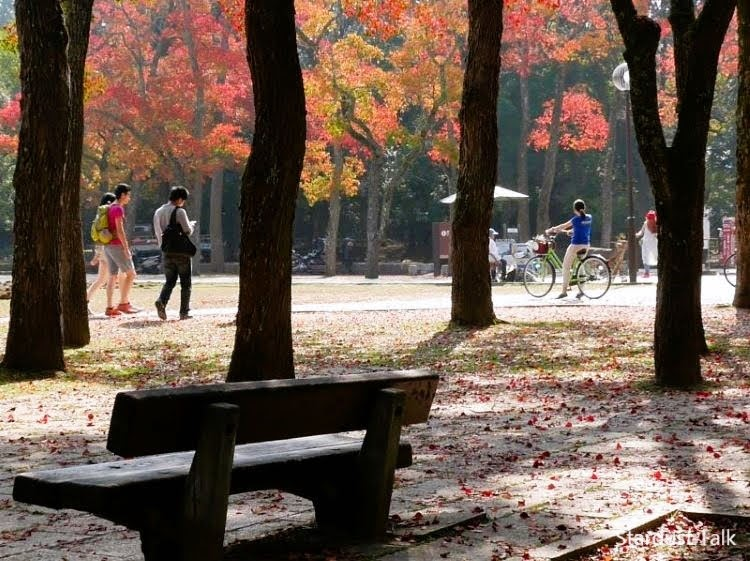
The Chinese Tallows seen from the bench in the old photo below are gone now.

2015


- At 飛火野 Tobihino -


This tall Chinese Tallow is a landmark of Tobihino.
Look at the tree in the golden glow before the sunset.


I was lucky that I could ride "Nara Deer Train" as it runs randomly.
At COLLOSAL, more photos and explanation about this adorably whimsical train.
"The Deer Train is decked out with lush, spotted seats, grassy flooring, 
handles shaped like pudgy animals, and illustrations by Tokyo-based artist Gemi 
that transform the cars into a whimsical, cervine world."


It's November, but the highest temperature of a day is forecasted to hover around
 25 degrees C at least for a week.

Linked to