Pages

Showing posts with label seascape. Show all posts

Monday, November 28, 2022

A glimpse into Nanki-Shirahama, a seaside hot spring town

While enjoying brilliance of continuous sunny, warm days,
autumn foliage is at their best as "Momiji", Japanese Maples, are rapidly 
turning colors to yellow to orange toward final burst of fiery red. 

Putting colored leaves aside for the next post, however,
I'll report my last-week trip  to Southern Wakayama Pref., especially 
Nanki-shirahama area, a seaside town facing the Pacific.
It is noted for spectacular rock formation, a beautiful beach, and hot spring.

Sandanbeki Cliff is a precipitous cliff, 2 kilometers long and 50 meters high. 
Visitors can go down by an elevator to see a hollow in the cave.
When the sea water enters the cave, it blows up through the hollow.


Rough waves break on the cliff.


The vast horizon makes you feel the beauty and magnificence of nature.


"Senjojiki" of Senjojiki Rock Plateau means "One Thousand Tatami Mats". 
Since Japan is an island country surrounded by the four oceans, the Okhotsuk,
the Pacific, the East China Sea and the Sea of Japan, there are about ten places 
at seashore with that name.
Visitors can walk out onto the flat, sheet-like rocks which lie on top of one another. 
The rock of Senjojiki was formed about 1.8 million to 65 million years ago
when the stratum was gradually eroded by the waves. 


Walking on Senjyojiki, you can closely experience the stunning steep coast 
denuded by raging waves of the ocean.


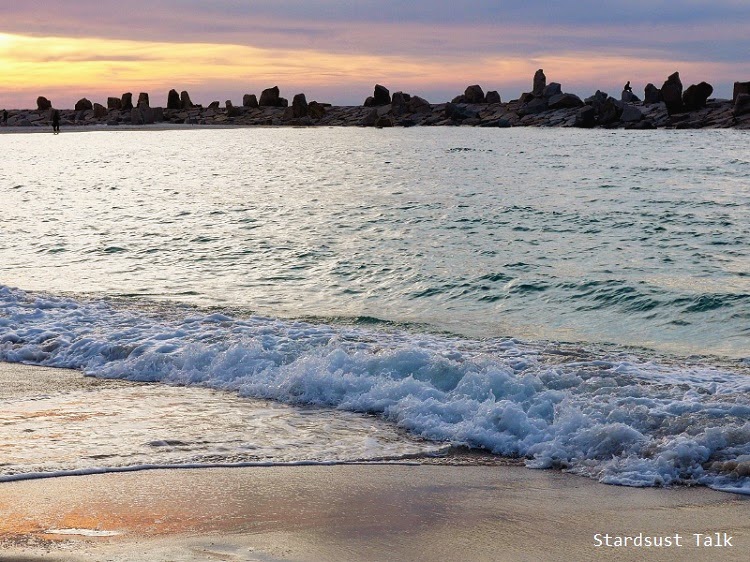
 Shirarahama Beach is famous for its sparkling white sand.
The white sand consists of mostly silica sand used in glass manufacturing.
Most of the current sand is from Australia as the rivers got unable to carry down
the white sand because of development.
Shirarahama Beach signed a partnership with Waikiki Beach in Honolulu, Hawaii
 as sister beaches.


The beach is also famous for its crystal-clear ocean.


Simply walking on the beach, which is not as busy as in the summer, is refreshing.
We could take our time to savor the beach during the sunset time.


Sunset therapy time!


The mosaic contains the Engetsudo Island, Tenjinzaki Cape, and a hot spring bath
in our hotel room other than the three sites mentioned above.
Engetsuto means "Island of the full moon".


It was a good break and diversion from the ongoing autumn foliage show.
I'll see you next time with fabulous colorful leaves of autumn.

Linked to Mosaic Monday

Monday, May 6, 2019

The blue sea of Nemophila by the Sea of Osaka


 Nemophilla Festival was held for the first time this year at Osaka Maishima Seaside Park 
located right in front of the Osaka Bay.

In 2014, I posted about flowering lilies at this place. 
Unfortunately the lilies got salt damage extensively caused by the typhoon 24 of the last autumn.
 Nemophilla replaced them this year.


The blue sea of Nemophila by the sea of Osaka.


 Nemophilla reminded me of “Sky-blue Flowers” by Misuzu Kaneko 
when I saw them for the first time in 2011.
Sky-Blue Flowers
(Misuzu Kaneko/translated by D.P.Dutcher)

Listen close, you little flowers,
Color of the blue, blue sky.
Around here there used to be
A pretty black-eyed girl,
Always looking at the sky
Like I was just doing now.
Dawn to dusk the blue sky
Shining in her eyes,
They turned one day to little flowers
That even now watch the sky.

If what I say is right, why,
Flowers, you must know
More about the real true sky
Than wise professors do.

I’m always looking at the sky
And thinking lots and lots
But what’s real and true I don’t know.
I bet you see it all and do.

Wise flowers don’t say a thing,
Just keep looking at the sky.
Those blue eyes, sky-dyed,
Still aren’t tired of watching.

(Original Japanese  空色の花 here)

The wise sky-dyed flowers don't standout when with other flowers,
letting others draw attention.
still keeping their uniqueness and originality.

A Mascot Character, Nemo-mew


Millions of Nemophila bloom from late-April to mid-May
as far as the eye can see.


The blue colors of the sky, the sea, and Nemophilla,
each blueness enhances the hues of one another.


Amagasaki, Nishinomiya, and Kobe Cities are spreading beyond the sea, 
surrounding the Osaka Bay.


Maishima, one of the three man-mad islands in the Sea of Osaka, 
is a possible site for the proposed casino development.
As it is called Sports Island, there are stadiums for baseball and football,
 tennis courts, playing grounds, sites for auto camping and barbecuing, etc. 
I’m not sure if such a place like casino is necessary to boost the place.


Linked to Mosaic Monday

Friday, October 21, 2016

Touring around Tango Peninshula

Tango peninsula juts up the Sea of Japan on the northern coast of Kyoto Prefecture.


Day One

Amanohashidate (天橋立), literally meaning “bridge in heaven,” 
is a 3.6 kilometer long sand bar clad with numerous pine trees. 
It spans across Miyazu Bay and is one of Japan's three most scenic views 
along with Miyajima and Matsushima


We walked the land bridge under the canopy of pine trees or along the water's edge.


The land bridge is best viewed from the hillside on either the south or north side of it. 
The observation deck at the Kasamatsu Park on the north side is a birthplace of “upside-down viewing." 
Turn your back to the land bridge, bend forward, and look at it  between your legs.
When you see a dragon floating to heaven, you'll have a good luck.

By the way, Japanese two researchers were awarded Ig Novel Prize for investigating
 how people perceive distances when they bend over and look between their legs. 
According to the research, things look a little nearer and smaller.

Three-year-old Y did upside-down viewing well.

Yuhigaura (夕日ヶ浦)is at the western coast of the peninsula.
The coast is famous for the beautiful sunset on the horizon.
The sun wasn't seen that evening.
but the scenery was simply beautiful with the slightly reddening horizon
and the darkening blue sea.


Surfers go surfing to the Sea of Japan for bigger waves from autumn to winter.
Winter is the best season.


A leisurely time in the traditional Japanese Inn’s room with an open-air bath.  
We had a good night sleep. 


Day Two

Kotobikihama (琴引き浜) Beach is about 1800 meters long with singing sands.


The town of Ine (伊根) is at the western coast of the peninsula.
It is an important preservation district for the traditional structures of Funaya boat houses,
the first floor for boat-slit and the second for dwelling.
These are the nearest houses to the sea in Japan.


Modern ships bigger than traditional ones got unable to stay in the first floor of Funaya.


Sandwitched between the mountains and the sea,
about 230 traditional structures are lined up for 5 kilometers along the Bay of Ine.


Two days before the trip, I cheered my granddaughters at the Sport Day event of their kindergarten.
Five-year-old F showed off group gymnastics, dance with color guard flags 
accompanying boys’ marching band, and relay; 
three-year-old Y ran a race and performed penguin dance. 
Two of them enjoyed fun games with their parents, too. 


While I enjoy each event with my families or friends in the lingering summer heat,
 season is progressing very slowly for sure.
The rest of October is also going to be eventful.
Keep tuned!

Linked to Friday Photo Journal

Tuesday, July 1, 2014

Flowering lilies by the sea at Maishima Island


In the late afternoon glow

A very large plot of land about 50,000 meter-square on Maishima Island is covered by about two million lilies from early-June to early-July.  Since it is hot and humid on a sunny day during the rainy season, I entered the lily garden around 5 p.m. and stayed till 7 p.m.  Because of the location, right beside the sea, sea breeze was comfortable.  What I saw was shimmering indigo-blue sea, clear blue sky, and lilies of various colors and species.
Konohana Bridge


At around 7:00 p.m., the sun was setting behind the mountains across the bay but big container ships were still busily passing by.  Incidantally today's sunset time is 7:13 in Osaka.


Maishima is a man-made island located in Osaka Bay. It was included in the candidate sites when Osaka had aimed to bid for Olympics but at that time I didn't know what it was like except for two things: one is the huge waste treatment plant with unique architectural appearance which looks like the work of Dali, and the other is as a site for Summer Sonic, one of the best rock festivals in Japan, which is held in Maishima every summer along with Makuhari.   On my first visit to the island I learned about the wide range of opportunities of sporting such as tennis courts, football stadium (base for Cerezo Osaka), baseball stadisum, indoor athletic field, spacious open dog-runs, racing circuits, barbecue garden, and so on.  I understood why it was called Maishima Sports Island in English.

Tuesday, January 21, 2014

Old mercantile buildings on the Kaigan-dori Street, Kobe


Large old mercantile buildings on Kobe Kaigan-dori Street of Route 2 
Effect of "impressive art"


Sometime in late 1800's or early 1900's, image via here
神戸旧居留地, Former Foreign Settlement of Kobe, was established as a place where foreigners (not all the foreigners but Europeans and Americans at first) could live and trade when the Port of Kobe opened according to the Ansei Treaties of Amity and Commerce (1858) concluded with the United States, Great Britain, Russia, Netherlands, and France, after long national isolation.

The settlement was designed by British civil engineers. 126 blocks in the district were sold to Western foreigners at auction. (The remaining building number is the block number.) The district spreads at the seaside between the east "Flower Road" and the west "Meriken Road".   The current traffic road was a sandy beach back then.

After the foreign settlement was returned back to Japanese government in 1899, Japanese businessmen also used this district and it became the business center of Kobe.

 With the start of World War II, most of the foreigners went back to their countries.  In 1945, about 70 percent of the buildings in this settlement were destroyed by air raids.

After the war, modern buildings were built while the remaining original buildings got older.  Until 1980’s, the district was simply old office streets with aged buildings, but in the late 1980’s civil movement to preserve the district got active, and besides, under the leadership of Daimaru Department Store, the mentality of the building owners changed to be conscious about “town-scape”, preserving dotted historical buildings to make a comprehensive nice and beautiful area.

In 1992, the district was designated as one of the top 100 beautiful city-scape in Japan. It is said to be one of the successful examples about the collaboration of civil movement and commercial capital.

After 1995 Great Hanshin Earthquake which collapsed more than 20 old buildings in this district, Kobe City government got involved actively in the restoration. The streets are protected not only through preservation but also with the understanding of how the landscape could be developed through the construction of new buildings. 


 Collapsed No. 15 Building, old American Consulate (1880), image via here

Reconstructed No. 15 Building, image via here
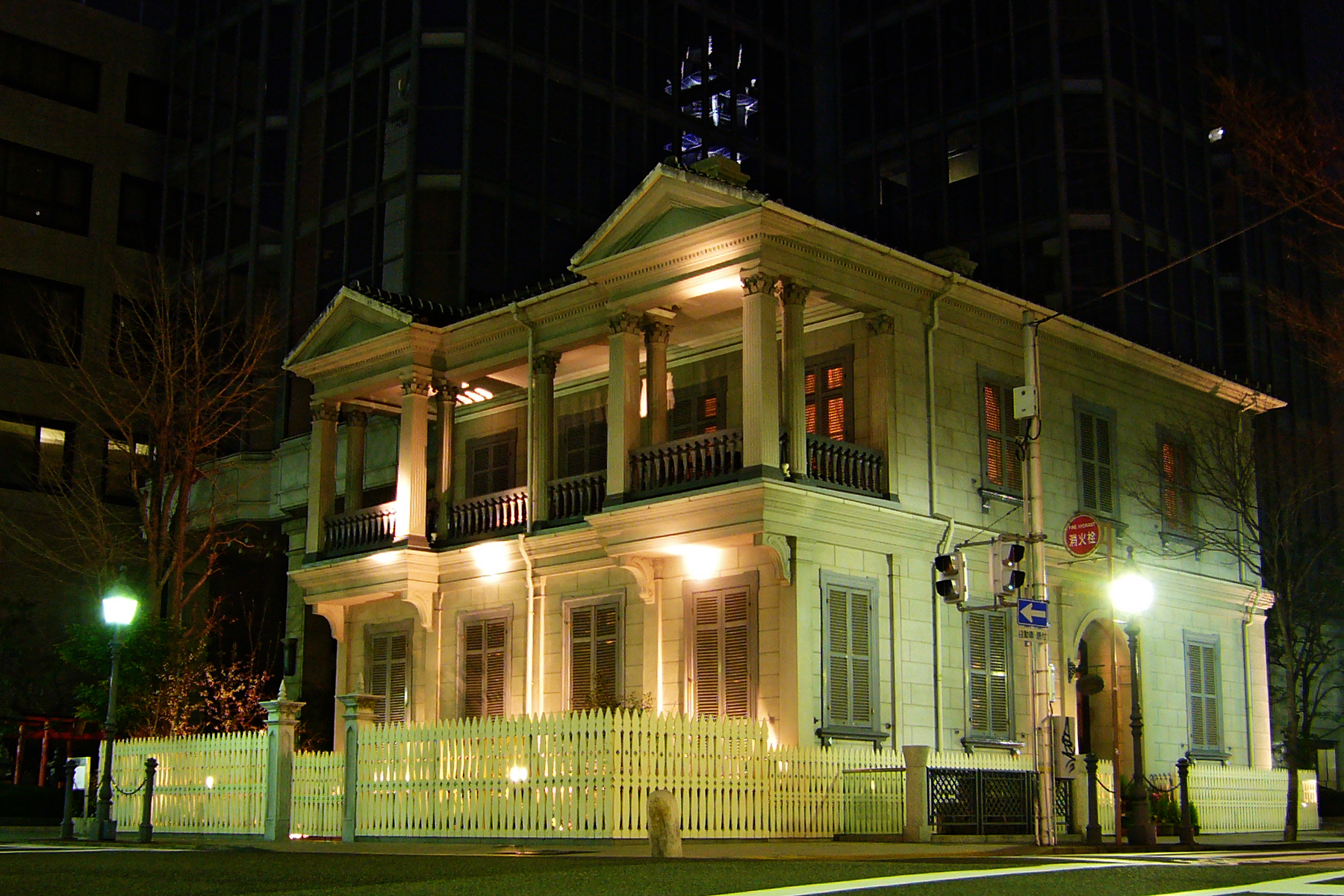
The building above, which was originally built in 1880 to house American Consulate, is the only building left from the Old Settlement days and is designated as an Important Cultural Property. It was destroyed completely during the 1995 earthquake, but was subsequently rebuilt using as much of the original materials as possible. It is used as a restaurant on the first floor and a cafe upstairs. I like it when historical assets are reused actively for practical various uses not only as museums. 


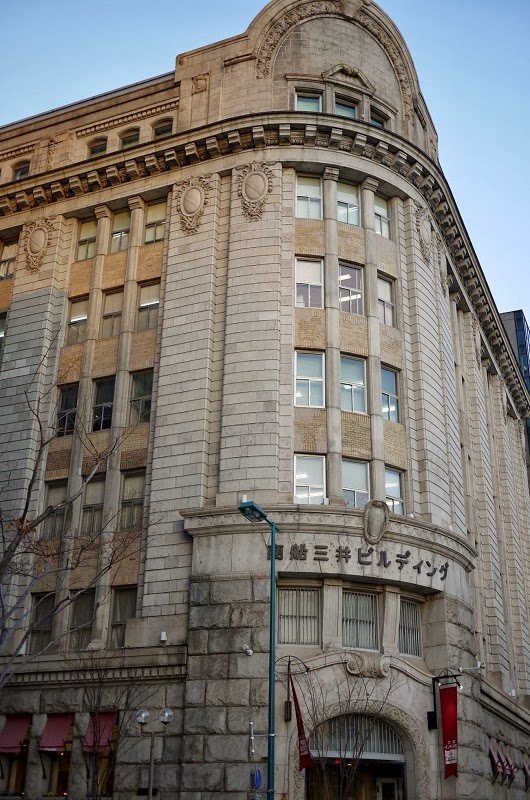
Let's see some of the European style buildings on the Kaigan-dori Street.  Shosen-Mitsui Building built in 1922 would be the most impressive and magnificent building. It is one of the most representative retro architectures with meticulous relief carving, beautiful vertical lines like carved pillars, and stately masonry at the lower part. With reinforcement and partly renovation, it is used by Daimaru to display furniture and interior goods in a large scale. 


Front entrance of Shosen-Mitsui Building
other entrance

Next to the  Shosen-Mitsui Building (right) is Kaigan Building (left).   It is a modern fifteen-story building including four-story classic building at the lower part.


This block used to be occupied by Kobe Branch of Mitsui-Bussan Co.  The original building collapsed in 1995 Hanshin Earthquake and was reconstructed as an office building of which 1-4 floor was reconstructed in original style, using the original materials found in debris as much as possible.  

Original door
Tofu and Yuba Restaurant


Across the street from Kaigan Building is former Kobe Branch of Nihon Yusen Co.  After the first American Consulate moved to the other place, the building of former Nihon-Yusen Co. was built in 1918.  It survived the earthquake because of the improved earthquake-resistance finished one year before.  Grand Back for big and tall men carries on business there currently.


I wonder if this is Frank Lloyd Wright door?


Right across the Kaigan-dori Street from the Grand Back is Meriken Pier.  

Walking around this district reminds me of the history of this city. This is the place where foreigners tried to make their dream come true by trade and commerce after sailing across the Pacific to the far-east Japan.  And besides, this city's history is a symbol of phoenix rising up.  After the devastation of the war and another devastation by the earthquake fifty years later, Kobe City resurrected like a phoenix and is constantly evolving.

Two-tired Hanshin Expressway, Kaigan-dori Street, Former Foreign Settlement seen from Meriken Pier