I woke up to the sound of the falling rain this morning. Due to the approaching typhoon, it will be raining and cool for a couple of days. After having survived sizzling heat, this is a relief, however, we need to be cautious as the typhoon is forecasted to be very strong and large.
Tenryu-ji Temple was established by Ashikaga Takauji in 1339 as one of the head temples of the Rinzai Zen School. It is one of Kyoto’s many UNESCO World Heritage sites.


Is it a universal custom to throw coins into the fountain?


Today's post is about what I liked about Tenryu-ji Temple, Kyoto, when I visited at the end of June during the rainy season.
 |
| Ground of Tenryu-ji near the bamboo grove |
Tenryu-ji Temple was established by Ashikaga Takauji in 1339 as one of the head temples of the Rinzai Zen School. It is one of Kyoto’s many UNESCO World Heritage sites.

Walking on a lovely path cutting through an awesome bamboo grove, which is behind the temple, I entered the temple. Green color was beautiful enriched by the rainfall while air was stifling due to high humidity.

Is it a universal custom to throw coins into the fountain?


 |
| Roofed corridor connecting the buildings |
Strolling around the gardens is always soothing experience even when it is sweltering. They includes every feature of Japanese landscape garden: paths of various types leading to views, a brook, ponds with carps, waterfront plants, and stones, bridges, lanterns, trellises, shakkei (borrowed scenery), seasonal flowers, exotic trees, etc..

I imagined colored leaves of the mountains and their reflection on the pond in autumn.
(seen from 大方丈, Daihojyo)
 Seen through the picture window of 小方丈, Shohojyo

曹源池庭園 (Sogen-chi Pond Garden), created by Muso Soseki, is the original garden of the ancient Tenryu-ji and is well known as a borrowed landscape garden incorporating Mt. Arashi. Mt. Atago, Mt. Ogura, and Mt. Kame in the backdrop. It is also the oldest 池泉回遊式庭園, pond strolling garden, in Japan.
Japanese water garden is full of asymmetries and curves. The pond is shaped like the Chinese character 心, "kokoro" in Japanese, which means enlightened Heart to Zen. "Kokoro" in Zen is not merely the state of consciousness, but is the essential self hood of man.

"Ryumon no taki/Ryumon Falls" in the center
The two-tiered composition of standing boulders represents “Ryumon no taki” which reminds people of the cascade where a carp successfully swimming up transform into a "ryu" (dragon) in the ancient Chinese legend.

Too slanting! The tree looked like a resting "ryu" to my eyes.

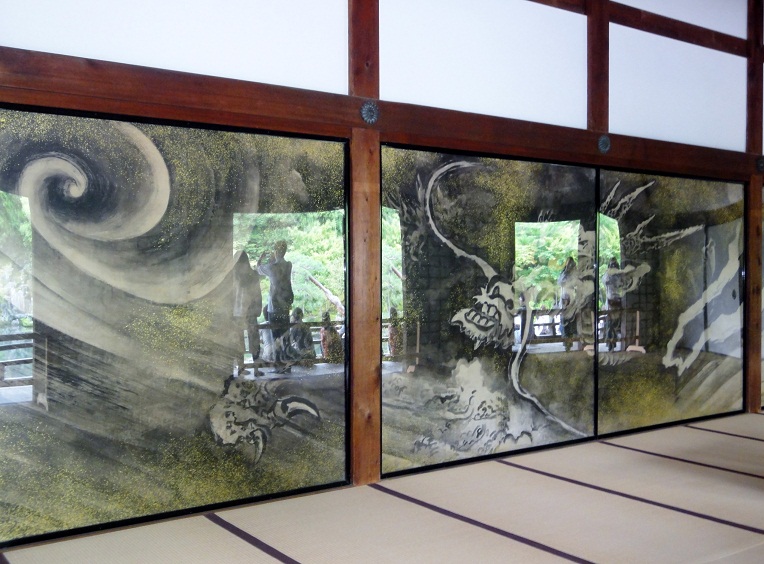
Ryu, a guardian beast of Buddhism, is painted on the paper sliding doors. Since they are protected by the glass covers, the garden and people are reflected. Sitting quietly, I felt like that the wind aroused by the dragon blowing to the garden. There is another ryu in Hatto (雲龍図, 法堂, No Photography) in the lecture hall of the temple. Tenryu-ji (天龍寺) literally means "Heaven-Ryu Temple".

Lovely stone statues welcoming or seeing off visitors along the path to the entrance.
Tenryuji is located in Sagano district, western outskirts of Kyoto. The area is famous for its cozy local atmosphere and beautiful scenery of mountains and riverside. My sister living in Kyoto says she never gets tired of visiting this place throughout the year. We didn't explore the area extensively due to other schedule. I'd like to return in other seasons.

Sightseeing boats
- To learn more about our world, please click on the picture of My World on the sidebar. -
